
2025 Retrospective: Best Practices, Lessons Learned, and 2026 Predictions
Introduction
2025 was a consolidation year where platform engineering, security-by-default, and pragmatic AI moved from ideas to operating standards. Teams that thrived adopted paved paths with built‑in identity, observability, and cost controls; those who didn’t often battled incidents and inconsistent delivery. This retrospective focuses on what actually worked across Azure, Power Platform, SharePoint, and .NET—and how to carry those wins into 2026.
This isn’t a feature recap. It’s a field guide for architects and platform owners to reduce incidents, accelerate delivery, and prove reliability with data. Each section offers concrete guardrails, code‑level examples, and KQL queries you can drop into workbooks today.
Use this as a shared baseline with security and engineering leadership. Start small: pick three improvements, pilot with one product team, and scale via templates and automation.
Prerequisites
| Requirement | Details |
|---|---|
| Basic setup and tooling | Basic setup and tooling |
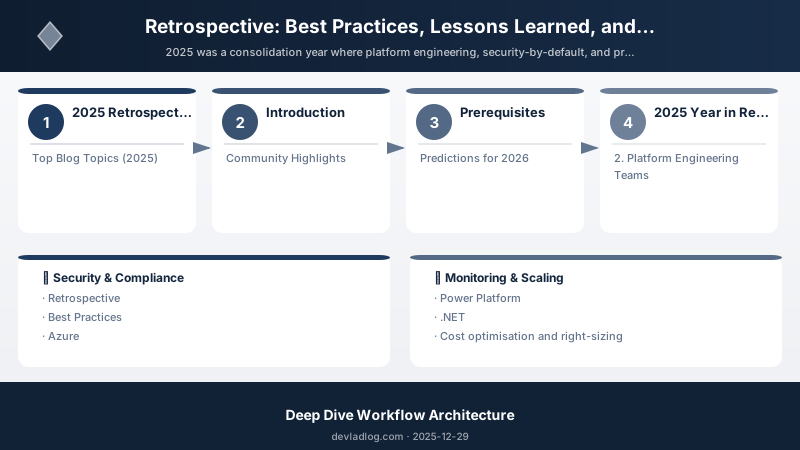
Figure: Solution architecture integrating 2025 retrospective—component interactions, data flows, authentication boundaries, and scalability patterns.
Figure: Implementation roadmap for 2025 retrospective—phased delivery, dependency management, risk mitigation, and success criteria.
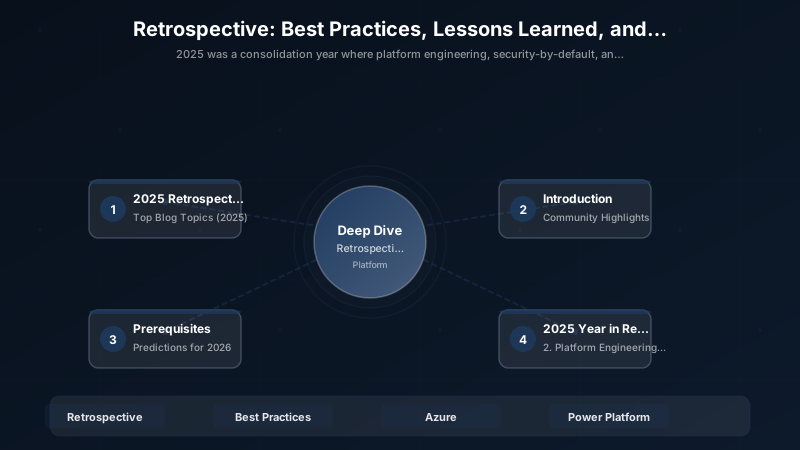
Figure: Operational model for 2025 retrospective—monitoring dashboards, incident response, capacity planning, and continuous improvement.
[Reflect on 2025 as transformative year: AI integration, serverless maturity, low-code expansion, DevOps evolution, security focus.]
2025 Year in Review
Azure Trends
Top Adopted Services:
- Azure Container Apps: Simplified Kubernetes alternative; autoscaling with KEDA
- Azure API Management: Gateway pattern for microservices; OAuth 2.0 integration
- Azure OpenAI Service: Enterprise AI with GPT-4; embeddings for semantic search
- Always On Availability Groups: High availability for SQL Server without Failover Cluster
- Azure Communication Services: Hybrid work platforms with Teams integration
Architecture Evolution:
["OrderId"] = orderId, ["CustomerId"] = customerId``` });
**Kusto Query for Error Analysis:**

```kql
exceptions
| where timestamp > ago(24h)
| summarize ErrorCount = count() by operation_Name, problemId
| order by ErrorCount desc
| take 10
Make SLOs explicit and alert on error‑budget burn, not just static thresholds. Correlate client pageViews with server requests using operation_Id. Sample at 5–10% for high‑volume telemetry, but never sample exceptions.
Slowest APIs by tenant (p95):
requests
| where timestamp > ago(24h)
| summarize p95_duration = percentiles(duration, 95) by tostring(customDimensions.Tenant), name
| top 20 by p95_duration desc
Lesson 3: Low-Code ≠ No-Code Governance
Problem: Uncontrolled Power Apps proliferation; data compliance risks
Solution: DLP policies + environment strategy + CoE toolkit
PowerShell: Create DLP Policy
New-DlpPolicy -DisplayName "Production Policy" -EnvironmentName (Get-AdminPowerAppEnvironment -Default | Select -ExpandName Name) -BlockNonBusinessDataGroup @("Shared SQL Server", "Azure Blob Storage") -BusinessDataGroup @("SharePoint", "Dataverse")
ALM baseline:
- Makers build in Dev using solutions; pipelines promote to Test and Prod with approvals.
- Managed solutions in Prod; no direct edits. Use connection references to avoid secret sprawl.
- CoE dashboards track orphaned apps/flows, connector usage, and DLP violations.
Lesson 4: Test Disaster Recovery Plans
Problem: Backup strategies untested until actual outage
Solution: Quarterly DR drills
SQL Restore Validation Script:
-- Automated restore test
RESTORE VERIFYONLY FROM DISK = 'C:\Backups\MyDatabase_Full.bak';

RESTORE DATABASE [MyDatabase_Test]
FROM DISK = 'C:\Backups\MyDatabase_Full.bak'
WITH MOVE 'MyDatabase' TO 'D:\Data\Test.mdf',
     MOVE 'MyDatabase_log' TO 'E:\Logs\Test_log.ldf';

DBCC CHECKDB ([MyDatabase_Test]) WITH NO_INFOMSGS;
Run quarterly DR days including API keys rotation checks, storage failover, DNS cutover, and APIM regional routing. Capture actual recovery times and compare with RTO/RPO.
Lesson 5: Cost Visibility Drives Optimization
Problem: Azure bills 3x projections; no accountability
Solution: Azure Cost Management + tagging + budgets
Tag Strategy:
| Tag | Purpose |
|---|---|
| Environment | Dev/Test/Prod |
| CostCenter | Chargeback |
| Owner | Accountability |
| Project | Budget tracking |
Azure CLI: Apply Tags
az resource tag --tags Environment=Production CostCenter=IT-001 --ids /subscriptions/.../resourceGroups/rg-prod/providers/Microsoft.Web/sites/myapp
FinOps moves:
- Budgets and action groups per product; notify product owners, not just ops.
- App Insights sampling + log retention policies; export critical business events to durable storage.
- APIM caching for idempotent GETs; throttle bursty tenants fairly.
- Anomaly detection for spend spikes:
usage
| where TimeGenerated > ago(30d)
| summarize cost = sum(PreTaxCost) by bin(TimeGenerated, 1d)
| evaluate series_decompose_anomalies(cost, 30, -1, 'linefit')
| where cost_anomalies > 0
Top Blog Topics (2025)
| Category | Most Popular Article | Key Takeaway |
|---|---|---|
| Azure | Multi-Tenant SaaS Architecture | Tenant isolation via Azure AD B2C + RLS |
| PowerApps | AI Builder in Power Platform | Sentiment analysis; document processing |
| SharePoint | Syntex AI-Powered Document Understanding | Automated metadata extraction |
| .NET | Minimal APIs in .NET | Lightweight services; 70% less boilerplate |
| SQL | Always On Availability Groups | High availability without clustering |
| Dynamics 365 | Business Process Flows | Streamlined operations; cross-entity workflows |
| Deep Dive | Hybrid Work Platform | Teams + SharePoint + Viva + ACS integration |
Community Highlights
Microsoft MVP Summit: 200+ MVPs shared real-world patterns
Build 2025: Azure Container Apps GA; Copilot for Azure announcements
Ignite 2025: Power Pages rebranding; Dynamics 365 Copilot enhancements
GitHub Universe: Copilot Enterprise launch; Actions improvements
Predictions for 2026
1. AI-First Application Development
Prediction: 60% of new apps will integrate LLMs (GPT-4, Llama)
Enablers: Azure OpenAI; Semantic Kernel; LangChain
Example Use Case: Intelligent document search with embeddings + RAG
# RAG pattern becomes standard
def rag_query(user_query):
```text
context = semantic_search(user_query, knowledge_base)
return gpt4_completion(f"Context: {context}\n\nQuery: {user_query}")
## 2. Platform Engineering Teams

**Prediction**: Enterprises will create dedicated platform teams managing internal developer platforms (IDP)


**Components**: Backstage (Spotify); Azure Container Apps; GitHub Actions

**Benefits**: Reduced time-to-production; standardized patterns

### 3. Data Mesh Adoption

**Prediction**: 40% of Fortune 500 will implement data mesh architecture

**Technologies**: Azure Data Lake; Databricks; Synapse Analytics; Power BI

**Pattern**: Domain-oriented data ownership; federated governance

### 4. Serverless Everywhere

**Prediction**: 70% of new Azure workloads will be serverless

**Services**: Container Apps; Functions; Logic Apps; Static Web Apps

**Cost Impact**: 50% reduction in compute costs vs VM-based architectures

### 5. Security-by-Default

**Prediction**: Zero Trust becomes mandatory for compliance

**Requirements**: Conditional Access; Continuous Access Evaluation (CAE); Passwordless

**Azure AD Features**: Risk-based policies; PIM (Privileged Identity Management)

### 6. Low-Code Platforms Mature

**Prediction**: Power Platform handles 50% of enterprise app development

**Capabilities**: Complex workflows; API integration; Custom connectors

**Governance**: ALM automation; CoE Starter Kit adoption

### 7. Edge Computing Growth

**Prediction**: 35% of IoT solutions deploy edge computing

**Azure Services**: IoT Edge; Azure Stack Edge; Arc-enabled Kubernetes

**Use Cases**: Real-time anomaly detection; offline-first scenarios

### 8. Developer Experience (DevEx) Focus

**Prediction**: DevEx becomes C-level priority

**Metrics**: Lead time for changes; deployment frequency; MTTR

**Tools**: GitHub Copilot; Codespaces; Playwright for testing

## Recommendations for 2026

### For Architects


- Adopt infrastructure as code (Bicep/Terraform) for all Azure resources
- Implement observability from day one (Application Insights + Kusto)
- Design for multi-region from start (reduces migration complexity)

Add platform guardrails:
- Golden paths (templates) for APIs/Functions/Container Apps with auth, health, and logging by default.
- Reusable APIM policy fragments (JWT, CORS, quotas) shipped via CI.
- Private endpoints and managed identities as the default posture.


### For Developers

- Learn prompt engineering for GitHub Copilot effectiveness
- Master async/await patterns for scalable APIs
- Contribute to open source (builds reputation + skills)

Developer experience:
- Dev containers + hot reload for a fast inner loop; keep pre‑commit hooks minimal.
- Roslyn analyzers/codemods enforce patterns automatically.
- Treat performance as a feature; include K6 scripts and baselines in CI.


### For Business Decision-Makers

- Invest in upskilling for Power Platform (democratizes development)
- Implement FinOps practices (cost visibility drives accountability)
- Prioritize security training (reduces incident frequency)

Operating model:
- Fund platforms as products with clear SLOs and roadmaps.
- Publish a monthly billing showback and review with product owners.
- Tie adoption goals (e.g., Power Platform maker training) to measurable outcomes.

---

## Operating Model Themes (2025)

- Shift‑left security and identity; templates include auth and logging.
- Template‑driven delivery with IaC, CI, SLOs, and dashboards baked in.
- Incident literacy: on‑call rotations, blameless postmortems, and versioned runbooks.


## Top Patterns and Anti‑Patterns

Patterns:
- Claims‑driven authorization across portal, APIs, and data stores.
- HPK (Cosmos) and RLS (SQL) for clean tenant isolation.
- Workbooks that join App Insights and Audit logs for unified views.


Anti‑patterns:
- Copying documents from SharePoint into databases for “convenience”.
- Emitting every profile attribute into tokens—oversized headers reduce reliability.
- One‑off YAML pipelines per repo; centralize templates.

## Troubleshooting Playbook Highlights

- Auth loops: verify redirect URIs, cookie domains, clock skew; confirm B2C issuer and key rollover.
- API timeouts: correlate gateway and backend via operation_Id; inspect p95 latency by tenant.
- Power Platform failures: alert on DLP violations and disabled connections; add proactive checks.
- SharePoint access issues: sensitivity labels and sharing settings drift; review access regularly.


KQL: Top failing operations with sample traces

```kql
traces
| where timestamp > ago(6h)
| where severityLevel >= 3
| summarize failures = count() by operation_Name
| top 20 by failures desc
2026 Action Plan (Quarterly)
- Q1: Standardize identity and APIM policies; ship templates and docs.
- Q2: Observability revamp—SLOs, workbooks, and burn‑rate alerts.
- Q3: FinOps guardrails—budgets, showback, anomaly alerts; right‑size resources.
- Q4: Reliability drills—regional failovers, chaos scenarios, incident game days.
Closing Thoughts
2025 demonstrated that:
- Cloud-native patterns mature: Container Apps simplified Kubernetes adoption
- AI integration accelerates: Azure OpenAI moved from experiment to production
- Low-code empowers: Power Platform reduced backlog by 40% in surveyed organizations
- Security requires culture shift: Zero Trust demands organizational commitment
Key Success Factors:
- Executive sponsorship for technology adoption
- Investment in training and certifications
- Iterative approach (fail fast, learn faster)
- Cross-functional collaboration (DevOps + Security + Business)
If you choose only three initiatives for 2026, pick identity hygiene, SLO‑driven observability, and platform templates. They compound quickly and pay off across every product.
Thank You
To all readers, contributors, and the Microsoft tech community—thank you for making 2025 a year of learning and growth. Here's to an even more innovative 2026!
Additional Resources
- Azure Architecture Center
- Power Platform Adoption Best Practices
- .NET Architecture Guides
- GitHub Copilot Documentation
- API Management policies (validate-jwt)
- Application Insights Workbooks
- Power Platform CoE Starter Kit
What will you build in 2026?
Architecture Decision and Tradeoffs
When designing integrated solutions solutions with Azure + Power Platform, consider these key architectural trade-offs:
| Approach | Best For | Tradeoff |
|---|---|---|
| Managed / platform service | Rapid delivery, reduced ops burden | Less customisation, potential vendor lock-in |
| Custom / self-hosted | Full control, advanced tuning | Higher operational overhead and cost |
Recommendation: Start with the managed approach for most workloads and move to custom only when specific requirements demand it.
Validation and Versioning
- Last validated: April 2026
- Validate examples against your tenant, region, and SKU constraints before production rollout.
- Keep module, CLI, and SDK versions pinned in automation pipelines and review quarterly.
Security and Governance Considerations
- Apply least-privilege access using RBAC roles and just-in-time elevation for admin tasks.
- Store secrets in managed secret stores and avoid embedding credentials in scripts or source files.
- Enable audit logging, data protection policies, and periodic access reviews for regulated workloads.
Cost and Performance Notes
- Define budgets and alerts, then monitor usage and cost trends continuously after go-live.
- Baseline performance with synthetic and real-user checks before and after major changes.
- Scale resources with measured thresholds and revisit sizing after usage pattern changes.
Official Microsoft References
- https://learn.microsoft.com/azure/architecture/
- https://learn.microsoft.com/azure/well-architected/
- https://learn.microsoft.com/power-platform/guidance/
Public Examples from Official Sources
- These examples are sourced from official public Microsoft documentation and sample repositories.
- Documentation examples: https://learn.microsoft.com/azure/well-architected/
- Sample repositories: https://github.com/Azure/ArchitectureCenter
- Prefer adapting these examples to your tenant, subscriptions, and governance requirements before production use.
Key Takeaways
- Practical, actionable guidance provided
Discussion