
Introduction: Cloud-Native Done Right
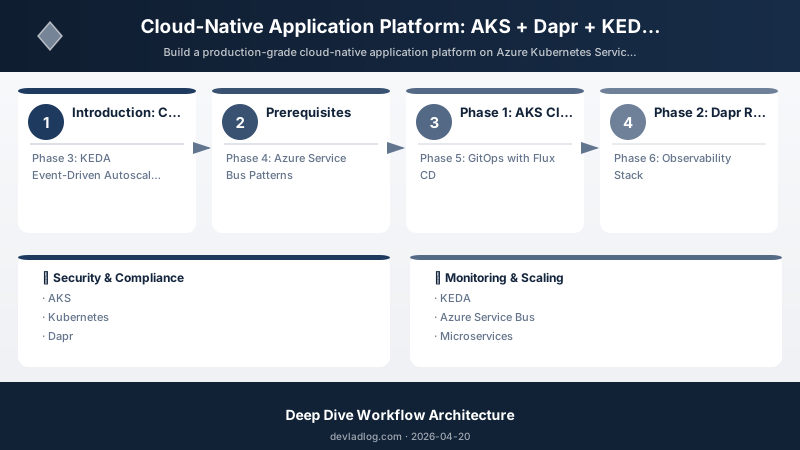
Building microservices is easy. Building production-grade microservices that are resilient, observable, secure, and cost-efficient is hard. This deep dive assembles a complete cloud-native platform on AKS, using Dapr to abstract away infrastructure complexity, KEDA for intelligent autoscaling, Azure Service Bus for reliable async messaging, and Flux for GitOps-driven deployments. The result is a platform that development teams can build on without worrying about the underlying distributed systems challenges.
Prerequisites
- Azure subscription with Contributor access
- Azure CLI 2.50+ with aks-preview extension
- kubectl and Helm 3.x installed
- Familiarity with Kubernetes, Docker, and microservice patterns
- Azure DevOps or GitHub for CI/CD pipelines
Phase 1: AKS Cluster Provisioning
Production-Grade Cluster with Bicep
param location string = resourceGroup().location
param clusterName string = 'aks-cloudnative-prod'

resource aksCluster 'Microsoft.ContainerService/managedClusters@2024-01-01' = {
  name: clusterName
  location: location
  identity: {
    type: 'SystemAssigned'
  }
  properties: {
    kubernetesVersion: '1.29'
    dnsPrefix: '${clusterName}-dns'
    enableRBAC: true
    aadProfile: {
      managed: true
      enableAzureRBAC: true
      adminGroupObjectIDs: ['admin-group-id']
    }
    networkProfile: {
      networkPlugin: 'azure'
      networkPolicy: 'calico'
      serviceCidr: '10.0.0.0/16'
      dnsServiceIP: '10.0.0.10'
      loadBalancerSku: 'standard'
      outboundType: 'userDefinedRouting'
    }
    agentPoolProfiles: [
      {
        name: 'system'
        count: 3
        vmSize: 'Standard_D4s_v5'
        osType: 'Linux'
        mode: 'System'
        availabilityZones: ['1', '2', '3']
        enableAutoScaling: true
        minCount: 3
        maxCount: 5
        nodeTaints: ['CriticalAddonsOnly=true:NoSchedule']
      }
      {
        name: 'apppool'
        count: 3
        vmSize: 'Standard_D8s_v5'
        osType: 'Linux'
        mode: 'User'
        availabilityZones: ['1', '2', '3']
        enableAutoScaling: true
        minCount: 3
        maxCount: 20
        nodeLabels: {
          workload: 'application'
        }
      }
      {
        name: 'gpupool'
        count: 0
        vmSize: 'Standard_NC6s_v3'
        osType: 'Linux'
        mode: 'User'
        enableAutoScaling: true
        minCount: 0
        maxCount: 4
        nodeLabels: {
          workload: 'gpu'
        }
        nodeTaints: ['nvidia.com/gpu=true:NoSchedule']
      }
    ]
    autoUpgradeProfile: {
      upgradeChannel: 'stable'
      nodeOSUpgradeChannel: 'NodeImage'
    }
    oidcIssuerProfile: { enabled: true }
    securityProfile: {
      workloadIdentity: { enabled: true }
      defender: { securityMonitoring: { enabled: true } }
      imageCleaner: { enabled: true, intervalHours: 48 }
    }
    addonProfiles: {
      omsagent: {
        enabled: true
        config: { logAnalyticsWorkspaceResourceID: logAnalytics.id }
      }
      azurepolicy: { enabled: true }
      azureKeyvaultSecretsProvider: {
        enabled: true
        config: { enableSecretRotation: 'true', rotationPollInterval: '2m' }
      }
    }
  }
}
Phase 2: Dapr Runtime for Microservice Abstractions
Installing and Configuring Dapr
# Install Dapr on AKS with HA mode
helm repo add dapr https://dapr.github.io/helm-charts/
helm repo update
helm install dapr dapr/dapr `
    --namespace dapr-system `
    --create-namespace `
    --set global.ha.enabled=true `
    --set dapr_placement.replicaCount=3 `
    --set dapr_sentry.replicaCount=3 `
    --set dapr_operator.replicaCount=3 `
    --set global.mtls.enabled=true `
    --set global.logAsJson=true `
    --version 1.13
Dapr Components for Azure Service Bus
# dapr-components/servicebus-pubsub.yaml
apiVersion: dapr.io/v1alpha1
kind: Component
metadata:
  name: order-pubsub
  namespace: production
spec:
  type: pubsub.azure.servicebus.topics
  version: v1
  metadata:
    - name: connectionString
      secretKeyRef:
        name: servicebus-secret
        key: connectionString
    - name: maxActiveMessages
      value: "100"
    - name: maxConcurrentHandlers
      value: "10"
    - name: lockRenewalInSec
      value: "60"
    - name: maxConnectionRecoveryInSec
      value: "300"
    - name: publishMaxRetries
      value: "5"
    - name: publishInitialRetryIntervalInMs
      value: "500"
  auth:
    secretStore: azure-keyvault
---
# dapr-components/statestore.yaml
apiVersion: dapr.io/v1alpha1
kind: Component
metadata:
  name: order-state
  namespace: production
spec:
  type: state.azure.cosmosdb
  version: v1
  metadata:
    - name: url
      value: "https://cloudnative-cosmos.documents.azure.com:443/"
    - name: masterKey
      secretKeyRef:
        name: cosmos-secret
        key: masterKey
    - name: database
      value: "orders"
    - name: collection
      value: "state"
    - name: actorStateStore
      value: "true"
  auth:
    secretStore: azure-keyvault
---
# dapr-components/bindings-blob.yaml
apiVersion: dapr.io/v1alpha1
kind: Component
metadata:
  name: document-storage
  namespace: production
spec:
  type: bindings.azure.blobstorage
  version: v1
  metadata:
    - name: accountName
      value: "cloudnativedocs"
    - name: accountKey
      secretKeyRef:
        name: storage-secret
        key: accountKey
    - name: containerName
      value: "documents"
  auth:
    secretStore: azure-keyvault
Microservice with Dapr SDK
// OrderService/Program.cs - .NET 8 microservice using Dapr
using Dapr.Client;
using Dapr.AspNetCore;

var builder = WebApplication.CreateBuilder(args);

builder.Services.AddDaprClient();
builder.Services.AddControllers().AddDapr();
builder.Services.AddHealthChecks();

var app = builder.Build();

app.UseCloudEvents();
app.MapSubscribeHandler();
app.MapControllers();
app.MapHealthChecks("/healthz");

app.Run();

// Controllers/OrderController.cs
[ApiController]
[Route("api/orders")]
public class OrderController : ControllerBase
{
    private readonly DaprClient _daprClient;
    private readonly ILogger<OrderController> _logger;

    public OrderController(DaprClient daprClient, ILogger<OrderController> logger)
    {
        _daprClient = daprClient;
        _logger = logger;
    }

    [HttpPost]
    public async Task<IActionResult> CreateOrder([FromBody] CreateOrderRequest request)
    {
        var order = new Order
        {
            Id = Guid.NewGuid().ToString(),
            CustomerId = request.CustomerId,
            Items = request.Items,
            Status = OrderStatus.Created,
            CreatedAt = DateTime.UtcNow,
            TotalAmount = request.Items.Sum(i => i.Price * i.Quantity)
        };

        // Save state to Cosmos DB via Dapr state store
        await _daprClient.SaveStateAsync("order-state", order.Id, order);

        // Publish order created event via Dapr pub/sub (Service Bus)
        await _daprClient.PublishEventAsync("order-pubsub", "orders", new OrderCreatedEvent
        {
            OrderId = order.Id,
            CustomerId = order.CustomerId,
            TotalAmount = order.TotalAmount,
            CreatedAt = order.CreatedAt
        });

        _logger.LogInformation("Order {OrderId} created for customer {CustomerId}", order.Id, order.CustomerId);
        return CreatedAtAction(nameof(GetOrder), new { id = order.Id }, order);
    }

    [Topic("order-pubsub", "payments")]
    [HttpPost("payment-completed")]
    public async Task<IActionResult> HandlePaymentCompleted([FromBody] PaymentCompletedEvent evt)
    {
        var order = await _daprClient.GetStateAsync<Order>("order-state", evt.OrderId);
        if (order == null) return NotFound();

        order.Status = OrderStatus.Paid;
        order.PaidAt = evt.PaidAt;

        await _daprClient.SaveStateAsync("order-state", order.Id, order);

        // Invoke shipping service via Dapr service invocation
        await _daprClient.InvokeMethodAsync(HttpMethod.Post, "shipping-service", "api/shipments", new
        {
            OrderId = order.Id,
            Address = order.ShippingAddress,
            Items = order.Items
        });

        return Ok();
    }
}
Phase 3: KEDA Event-Driven Autoscaling
Scaling Based on Azure Service Bus Queue Depth
# keda/order-processor-scaler.yaml
apiVersion: keda.sh/v1alpha1
kind: ScaledObject
metadata:
  name: order-processor-scaler
  namespace: production
spec:
  scaleTargetRef:
    name: order-processor
  pollingInterval: 15
  cooldownPeriod: 60
  minReplicaCount: 1
  maxReplicaCount: 30
  fallback:
    failureThreshold: 3
    replicas: 5
  triggers:
    - type: azure-servicebus
      metadata:
        queueName: order-processing
        namespace: cloudnative-bus
        messageCount: "10"
        activationMessageCount: "1"
        connectionFromEnv: SERVICEBUS_CONNECTION
    - type: cron
      metadata:
        timezone: "America/New_York"
        start: "0 8 * * 1-5"
        end: "0 20 * * 1-5"
        desiredReplicas: "5"
---
# Scale based on HTTP traffic using Prometheus metrics
apiVersion: keda.sh/v1alpha1
kind: ScaledObject
metadata:
  name: api-gateway-scaler
  namespace: production
spec:
  scaleTargetRef:
    name: api-gateway
  pollingInterval: 10
  cooldownPeriod: 120
  minReplicaCount: 3
  maxReplicaCount: 50
  triggers:
    - type: prometheus
      metadata:
        serverAddress: http://prometheus-server.monitoring:9090
        metricName: http_requests_per_second
        query: |
          sum(rate(http_requests_total{app="api-gateway"}[2m]))
        threshold: "200"
        activationThreshold: "50"
    - type: cpu
      metricType: Utilization
      metadata:
        value: "70"
    - type: memory
      metricType: Utilization
      metadata:
        value: "80"
Phase 4: Azure Service Bus Patterns
Dead Letter Processing and Retry Logic
public class ServiceBusDeadLetterProcessor : BackgroundService
{
    private readonly ServiceBusClient _client;
    private readonly ILogger<ServiceBusDeadLetterProcessor> _logger;

    protected override async Task ExecuteAsync(CancellationToken stoppingToken)
    {
        var dlqReceiver = _client.CreateReceiver(
            "order-processing",
            new ServiceBusReceiverOptions
            {
                SubQueue = SubQueue.DeadLetter,
                ReceiveMode = ServiceBusReceiveMode.PeekLock
            });

        while (!stoppingToken.IsCancellationRequested)
        {
            var messages = await dlqReceiver.ReceiveMessagesAsync(
                maxMessages: 10,
                maxWaitTime: TimeSpan.FromSeconds(30),
                cancellationToken: stoppingToken);

            foreach (var message in messages)
            {
                var deadLetterReason = message.DeadLetterReason;
                var errorDescription = message.DeadLetterErrorDescription;

                _logger.LogWarning(
                    "Dead letter: {Reason} - {Description} for message {Id}",
                    deadLetterReason, errorDescription, message.MessageId);

                // Analyze and route dead letters
                if (IsRetryable(deadLetterReason))
                {
                    // Re-enqueue with exponential backoff
                    var retryCount = message.ApplicationProperties.ContainsKey("RetryCount")
                        ? (int)message.ApplicationProperties["RetryCount"] + 1 : 1;

                    if (retryCount <= 5)
                    {
                        var sender = _client.CreateSender("order-processing");
                        var retryMessage = new ServiceBusMessage(message.Body)
                        {
                            MessageId = message.MessageId,
                            ScheduledEnqueueTime = DateTimeOffset.UtcNow.AddSeconds(Math.Pow(2, retryCount) * 10)
                        };
                        retryMessage.ApplicationProperties["RetryCount"] = retryCount;
                        await sender.SendMessageAsync(retryMessage, stoppingToken);
                    }
                    else
                    {
                        await ParkMessageAsync(message);
                    }
                }
                else
                {
                    await ParkMessageAsync(message);
                }

                await dlqReceiver.CompleteAsync(message, stoppingToken);
            }
        }
    }
}
Phase 5: GitOps with Flux CD
Repository Structure and Flux Configuration
# flux-system/gotk-sync.yaml
apiVersion: source.toolkit.fluxcd.io/v1
kind: GitRepository
metadata:
  name: platform-config
  namespace: flux-system
spec:
  interval: 1m
  url: https://dev.azure.com/org/project/_git/platform-config
  ref:
    branch: main
  secretRef:
    name: git-credentials
---
apiVersion: kustomize.toolkit.fluxcd.io/v1
kind: Kustomization
metadata:
  name: infrastructure
  namespace: flux-system
spec:
  interval: 5m
  path: ./infrastructure
  prune: true
  sourceRef:
    kind: GitRepository
    name: platform-config
  healthChecks:
    - apiVersion: apps/v1
      kind: Deployment
      name: dapr-operator
      namespace: dapr-system
  dependsOn: []
---
apiVersion: kustomize.toolkit.fluxcd.io/v1
kind: Kustomization
metadata:
  name: applications
  namespace: flux-system
spec:
  interval: 5m
  path: ./applications/production
  prune: true
  sourceRef:
    kind: GitRepository
    name: platform-config
  dependsOn:
    - name: infrastructure
  postBuild:
    substitute:
      ENVIRONMENT: production
      CLUSTER_NAME: aks-cloudnative-prod
Phase 6: Observability Stack
OpenTelemetry Configuration
# otel-collector/config.yaml
apiVersion: v1
kind: ConfigMap
metadata:
  name: otel-collector-config
  namespace: monitoring
data:
  otel-collector-config.yaml: |
    receivers:
      otlp:
        protocols:
          grpc:
            endpoint: 0.0.0.0:4317
          http:
            endpoint: 0.0.0.0:4318
      prometheus:
        config:
          scrape_configs:
            - job_name: 'dapr'
              scrape_interval: 15s
              kubernetes_sd_configs:
                - role: pod
              relabel_configs:
                - source_labels: [__meta_kubernetes_pod_annotation_dapr_io_metrics_port]
                  action: keep
                  regex: '.+'

    processors:
      batch:
        timeout: 10s
        send_batch_size: 1024
      memory_limiter:
        limit_mib: 512
        spike_limit_mib: 128
        check_interval: 5s
      resource:
        attributes:
          - key: environment
            value: production
            action: upsert
          - key: cloud.provider
            value: azure
            action: upsert

    exporters:
      azuremonitor:
        connection_string: ${APPLICATIONINSIGHTS_CONNECTION_STRING}
      prometheus:
        endpoint: 0.0.0.0:8889

    service:
      pipelines:
        traces:
          receivers: [otlp]
          processors: [memory_limiter, batch, resource]
          exporters: [azuremonitor]
        metrics:
          receivers: [otlp, prometheus]
          processors: [memory_limiter, batch]
          exporters: [azuremonitor, prometheus]
        logs:
          receivers: [otlp]
          processors: [memory_limiter, batch]
          exporters: [azuremonitor]
Platform Decision Matrix
| Concern | Technology | Why |
|---|---|---|
| Container Orchestration | AKS | Managed Kubernetes, Azure-native |
| Service Communication | Dapr | Infrastructure abstraction, mTLS, pub/sub |
| Autoscaling | KEDA | Event-driven, scales to zero, multi-trigger |
| Messaging | Azure Service Bus | Enterprise reliability, dead letter, sessions |
| Deployment | Flux CD | GitOps, drift detection, multi-tenancy |
| Observability | OpenTelemetry + Azure Monitor | Vendor-neutral, distributed tracing |
| Secrets | Key Vault + CSI Driver | Auto-rotation, managed identity |
| Networking | Calico | Network policies, microsegmentation |
Best Practices
- Use Dapr for service-to-service calls: Automatic retries, mTLS, and observability without code changes
- KEDA over HPA for event-driven workloads: Scale based on queue depth, not just CPU/memory
- GitOps is non-negotiable: Never kubectl apply in production — always go through Git
- Separate system and application node pools: Prevent application workloads from starving system components
- Implement circuit breakers: Use Dapr's built-in retry and circuit breaker policies
- Dead letter queues from day one: Every Service Bus subscription should have DLQ processing
- Use workload identity over service principals: Pod-level managed identity is more secure
Troubleshooting
| Issue | Root Cause | Resolution |
|---|---|---|
| Dapr sidecar not injecting | Missing annotation or namespace label | Add dapr.io/enabled: "true" annotation |
| KEDA not scaling | Trigger authentication failure | Verify TriggerAuthentication secret references |
| Service Bus message loss | Message not completed before lock expires | Increase lock duration, add renewal logic |
| Flux drift detected | Manual change outside GitOps | Revert manual change, update Git source |
| High latency between services | Missing Dapr service invocation | Use Dapr service invocation, not direct HTTP |
Architecture Decision and Tradeoffs
When designing integrated solutions solutions with Azure + Power Platform, consider these key architectural trade-offs:
| Approach | Best For | Tradeoff |
|---|---|---|
| Managed / platform service | Rapid delivery, reduced ops burden | Less customisation, potential vendor lock-in |
| Custom / self-hosted | Full control, advanced tuning | Higher operational overhead and cost |
Recommendation: Start with the managed approach for most workloads and move to custom only when specific requirements demand it.
Validation and Versioning
- Last validated: April 2026
- Validate examples against your tenant, region, and SKU constraints before production rollout.
- Keep module, CLI, and SDK versions pinned in automation pipelines and review quarterly.
Security and Governance Considerations
- Apply least-privilege access using RBAC roles and just-in-time elevation for admin tasks.
- Store secrets in managed secret stores and avoid embedding credentials in scripts or source files.
- Enable audit logging, data protection policies, and periodic access reviews for regulated workloads.
Cost and Performance Notes
- Define budgets and alerts, then monitor usage and cost trends continuously after go-live.
- Baseline performance with synthetic and real-user checks before and after major changes.
- Scale resources with measured thresholds and revisit sizing after usage pattern changes.
Official Microsoft References
- https://learn.microsoft.com/azure/architecture/
- https://learn.microsoft.com/azure/well-architected/
- https://learn.microsoft.com/power-platform/guidance/
Public Examples from Official Sources
- These examples are sourced from official public Microsoft documentation and sample repositories.
- Documentation examples: https://learn.microsoft.com/azure/well-architected/
- Sample repositories: https://github.com/Azure/ArchitectureCenter
- Prefer adapting these examples to your tenant, subscriptions, and governance requirements before production use.
Key Takeaways
- A cloud-native platform is more than Kubernetes — it requires service mesh, event-driven scaling, reliable messaging, and GitOps
- Dapr eliminates boilerplate distributed systems code while remaining runtime-agnostic
- KEDA enables true event-driven architectures that scale to zero during idle periods
- Azure Service Bus provides enterprise-grade messaging with dead letter handling and sessions
- GitOps with Flux ensures every deployment is auditable, reversible, and repeatable
Discussion