Nintex K2: Implementation Blueprint and Hands-On Walkthrough (2025)
Introduction
Nintex K2: Implementation Blueprint and Hands-On Walkthrough (2025) is a practical guide for enterprise workflow orchestration. In 2025, enterprise teams need to deliver quickly without losing governance posture. In many projects, integration failures often happen at boundaries between systems, not inside individual tools.
This article follows the same approach as the stronger categories in this blog: clear architecture decisions, implementation discipline, and production operations readiness.
Business Context and Value
| Objective | Execution Focus | Measurable Outcome |
|---|---|---|
| Faster delivery | Reusable standards and automation | Lower lead time and fewer failed changes |
| Security posture | Built-in controls and approvals | Fewer high-severity findings |
| Operational reliability | Observability and ownership model | Reduced MTTR and incident recurrence |
| Scalable governance | Guardrails for autonomous teams | Consistent quality across domains |
Implementation Blueprint
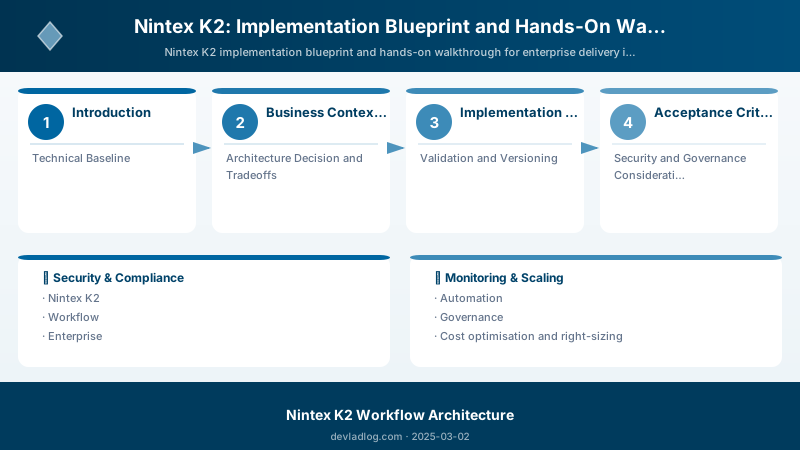
Phase 1: Foundation
- Baseline identity, environment topology, and policy controls.
- Create reusable templates and CI validation gates.
Phase 2: Pilot
- Deliver one representative workload end-to-end.
- Validate reliability, security, and support handoff.
Phase 3: Scale
- Replicate proven patterns across domains.
- Track deployment quality metrics and incident trends.
Acceptance Criteria
- All quality gates pass in CI for release candidates.
- Runbooks are validated in non-production drills.
- High-risk findings are resolved before production promotion.
Technical Baseline
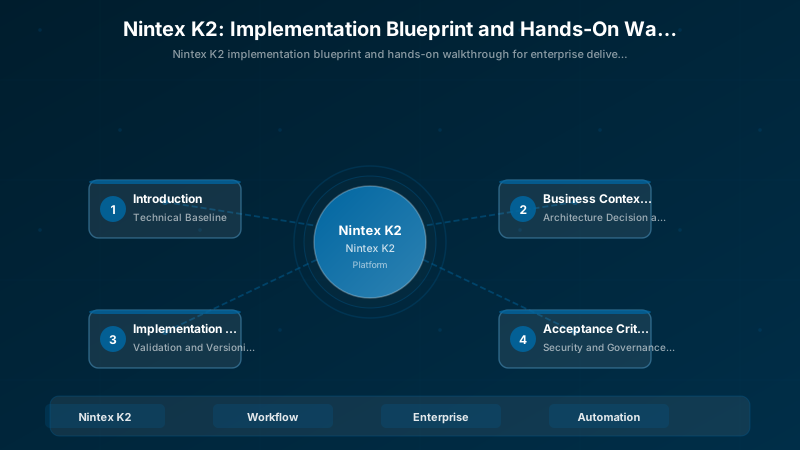
Primary stack: Nintex K2, SmartObjects, SharePoint Online, Power Automate, Azure AD.
# K2 integration validation
Write-Host "Validate SmartObject connectivity"
Write-Host "Validate SharePoint and identity permissions"
Write-Host "Execute end-to-end workflow smoke test"
Architecture Decision and Tradeoffs
When designing process automation solutions with Nintex K2, consider these key architectural trade-offs:
| Approach | Best For | Tradeoff |
|---|---|---|
| Managed / platform service | Rapid delivery, reduced ops burden | Less customisation, potential vendor lock-in |
| Custom / self-hosted | Full control, advanced tuning | Higher operational overhead and cost |
Recommendation: Start with the managed approach for most workloads and move to custom only when specific requirements demand it.
Validation and Versioning
- Validate in dev, test, and pre-production before production promotion.
- Use semantic versioning for reusable assets and integration contracts.
- Keep release notes tied to risk impact and rollback strategy.
- Block promotions when quality gates fail.
Security and Governance Considerations
- Apply least privilege and separate build, release, and operations permissions.
- Externalize secrets and enforce rotation cadence.
- Require auditable approvals for high-risk changes.
- Keep immutable logs for production changes and privileged operations.
Cost and Performance Notes
- Set baseline latency, error-rate, and cost metrics before optimization.
- Prioritize highest-value bottlenecks first using telemetry evidence.
- Remove stale resources and unused components in scheduled governance reviews.
- Prefer reliability and predictability before advanced tuning.
Troubleshooting and Operations Tips
- Treat recurring incidents as design feedback.
- Maintain versioned incident runbooks and test them in drills.
- Keep clear escalation ownership and communication paths.
- Convert post-incident learnings into template or policy updates.
Official Microsoft References
- Nintex K2 Documentation: https://help.nintex.com/en-US/k2five/
- SharePoint Documentation: https://learn.microsoft.com/sharepoint/
- Power Automate Documentation: https://learn.microsoft.com/power-automate/
- Azure Well-Architected Framework: https://learn.microsoft.com/azure/well-architected/
- Microsoft Cloud Adoption Framework: https://learn.microsoft.com/azure/cloud-adoption-framework/
Public Examples from Official Sources
- Public reference implementations adapted to enterprise governance requirements.
- Microsoft and partner tutorials hardened with production controls.
- Community examples validated with reliability and security practices.
Anti-Patterns to Avoid
- Implementing point-to-point connectors without a canonical integration contract.
- Granting broad permissions to workflow identities outside formal change control.
- Skipping end-to-end replay tests across K2, SharePoint, and Power Automate.
30-Day Rollout Plan
- Week 1: Baseline integration map, ownership, and security boundaries.
- Week 2: Build smoke tests for all critical workflow paths and callbacks.
- Week 3: Enable staged promotion with rollback checkpoints and audit evidence.
- Week 4: Harden observability and close recurring failure patterns.
KPI Scorecard
| KPI | Target |
|---|---|
| Integration success rate | >= 99% |
| Approval SLA adherence | >= 95% |
| Critical workflow incident recurrence | <= 5% |
| Mean time to detect integration failures | < 15 minutes |
Conclusion
Nintex K2: Implementation Blueprint and Hands-On Walkthrough (2025) is most effective when architecture, engineering workflow, and governance are designed together from day one. Use this as a baseline and adapt controls to your compliance and delivery context.
Discussion