Terraform: Architecture Patterns and Decision Framework (2026)
Introduction
Terraform: Architecture Patterns and Decision Framework (2026) is a practical guide for multi-environment provisioning and policy-as-code governance. In 2026, enterprise teams need to deliver quickly without losing governance posture. In many projects, state hygiene, permission boundaries, and cost controls drift under rapid delivery pressure.
This article follows the same approach as the stronger categories in this blog: clear architecture decisions, implementation discipline, and production operations readiness.
Business Context and Value
| Objective | Execution Focus | Measurable Outcome |
|---|---|---|
| Faster delivery | Reusable standards and automation | Lower lead time and fewer failed changes |
| Security posture | Built-in controls and approvals | Fewer high-severity findings |
| Operational reliability | Observability and ownership model | Reduced MTTR and incident recurrence |
| Scalable governance | Guardrails for autonomous teams | Consistent quality across domains |
Architecture Decision Framework
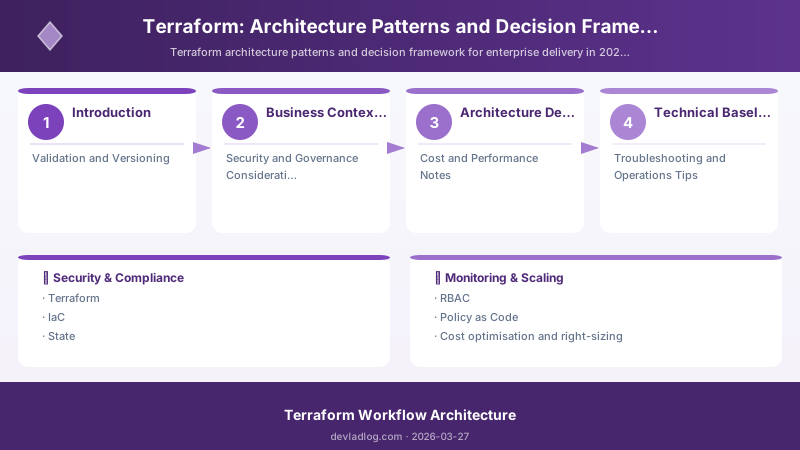
Use this framework to select a sustainable implementation pattern:
- Control model: centralized governance with federated execution.
- Change model: small increments with rollback checkpoints.
- Ownership model: explicit boundaries for platform, product, and operations teams.
| Decision Axis | Option A | Option B | Preferred Enterprise Pattern |
|---|---|---|---|
| Delivery ownership | Central platform only | Distributed teams | Distributed teams + central guardrails |
| Environment strategy | Shared mutable environments | Isolated promotion pipeline | Isolated pipeline with promotion gates |
| Compliance evidence | Manual capture | Automated capture | Automated evidence as default |
Technical Baseline
Primary stack: Terraform, remote state backends, AzureRM provider, RBAC, policy controls.
terraform fmt -recursive
terraform init -upgrade
terraform validate
terraform plan -out tfplan
terraform apply tfplan
Validation and Versioning
- Validate in dev, test, and pre-production before production promotion.
- Use semantic versioning for reusable assets and integration contracts.
- Keep release notes tied to risk impact and rollback strategy.
- Block promotions when quality gates fail.
Security and Governance Considerations
- Apply least privilege and separate build, release, and operations permissions.
- Externalize secrets and enforce rotation cadence.
- Require auditable approvals for high-risk changes.
- Keep immutable logs for production changes and privileged operations.
Cost and Performance Notes
- Set baseline latency, error-rate, and cost metrics before optimization.
- Prioritize highest-value bottlenecks first using telemetry evidence.
- Remove stale resources and unused components in scheduled governance reviews.
- Prefer reliability and predictability before advanced tuning.
Troubleshooting and Operations Tips
- Treat recurring incidents as design feedback.
- Maintain versioned incident runbooks and test them in drills.
- Keep clear escalation ownership and communication paths.
- Convert post-incident learnings into template or policy updates.
Official Microsoft References
- Terraform Language Docs: https://developer.hashicorp.com/terraform/language
- AzureRM Provider Docs: https://registry.terraform.io/providers/hashicorp/azurerm/latest/docs
- Azure Well-Architected: https://learn.microsoft.com/azure/well-architected/
- Azure Well-Architected Framework: https://learn.microsoft.com/azure/well-architected/
- Microsoft Cloud Adoption Framework: https://learn.microsoft.com/azure/cloud-adoption-framework/
Public Examples from Official Sources
- Public reference implementations adapted to enterprise governance requirements.
- Microsoft and partner tutorials hardened with production controls.
- Community examples validated with reliability and security practices.
Anti-Patterns to Avoid
- Using one shared state for unrelated environments and workloads.
- Over-privileged automation identities without scoped RBAC boundaries.
- Reviewing cost variance only after month-end billing surprises.
30-Day Rollout Plan
- Week 1: Segment state layout and enforce RBAC boundaries.
- Week 2: Add mandatory plan review and policy checks in CI.
- Week 3: Implement budget alerts and anomaly detection thresholds.
- Week 4: Prioritize optimization backlog from telemetry and spend data.
KPI Scorecard
| KPI | Target |
|---|---|
| Policy check pass rate | >= 97% |
| Unauthorized changes blocked | 100% |
| Monthly cost variance | <= 8% |
| State lock contention incidents | <= 1 per month |
Conclusion
Terraform: Architecture Patterns and Decision Framework (2026) is most effective when architecture, engineering workflow, and governance are designed together from day one. Use this as a baseline and adapt controls to your compliance and delivery context.
Discussion