
!Architecture Overview
Background Services in .NET: IHostedService, Workers, and Queue Processing
Introduction
Prerequisites
| Requirement | Details |
|---|---|
| .NET SDK installed | .NET SDK installed |
| VS Code or Visual Studio | VS Code or Visual Studio |
| Git installed | Git installed |
Figure: Code architecture demonstrating background services in .net—layered design, dependency injection patterns, interface abstractions, and testability considerations.
Figure: Performance benchmarking results for background services in .net—throughput metrics, latency percentiles, memory allocation profiles, and optimization opportunities.
Figure: Deployment pipeline for background services in .net—build automation, test execution, package publication, and production release workflow.
Background services handle long-running operations outside HTTP request lifecycles: scheduled tasks, queue processing, data synchronization, and monitoring. This guide covers IHostedService and BackgroundService fundamentals, worker service applications, scheduled tasks with Quartz.NET and Hangfire, queue processing patterns with channels and message queues, and graceful shutdown for reliable operation.
IHostedService Fundamentals
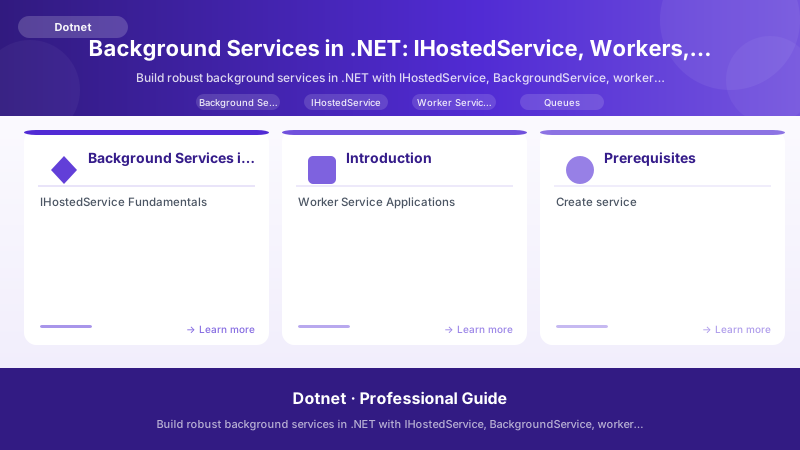
Figure: Program.cs – service registration with IntelliSense for DI lifetimes.
Basic Implementation
Simple hosted service:
public class DataSyncService : IHostedService
{
```text
private readonly ILogger<DataSyncService> _logger;
private Timer? _timer;

public DataSyncService(ILogger<DataSyncService> logger)
{
    _logger = logger;
}

public Task StartAsync(CancellationToken cancellationToken)
{
    _logger.LogInformation("Data sync service starting");

    // Execute every 5 minutes
    _timer = new Timer(DoWork, null, TimeSpan.Zero, TimeSpan.FromMinutes(5));

    return Task.CompletedTask;
}

private void DoWork(object? state)
{
    _logger.LogInformation("Syncing data at {Time}", DateTime.UtcNow);
    // Perform sync operation
}

public Task StopAsync(CancellationToken cancellationToken)
{
    _logger.LogInformation("Data sync service stopping");

    _timer?.Change(Timeout.Infinite, 0);
    _timer?.Dispose();

    return Task.CompletedTask;
}```
}

// Registration
builder.Services.AddHostedService<DataSyncService>();
BackgroundService Base Class
Simplified background work:
public class EmailQueueService : BackgroundService
{
```csharp
private readonly ILogger<EmailQueueService> _logger;
private readonly IServiceScopeFactory _scopeFactory;

public EmailQueueService(
    ILogger<EmailQueueService> logger,
    IServiceScopeFactory scopeFactory)
{
    _logger = logger;
    _scopeFactory = scopeFactory;
}

protected override async Task ExecuteAsync(CancellationToken stoppingToken)
{
    _logger.LogInformation("Email queue service is starting");

    while (!stoppingToken.IsCancellationRequested)
    {
        try
        {
            await ProcessEmailQueueAsync(stoppingToken);
            await Task.Delay(TimeSpan.FromSeconds(10), stoppingToken);
        }
        catch (OperationCanceledException)
        {
            // Expected during shutdown
            break;
        }
        catch (Exception ex)
        {
            _logger.LogError(ex, "Error processing email queue");
            await Task.Delay(TimeSpan.FromMinutes(1), stoppingToken);
        }
    }

    _logger.LogInformation("Email queue service is stopping");
}

private async Task ProcessEmailQueueAsync(CancellationToken cancellationToken)
{
    using var scope = _scopeFactory.CreateScope();
    var emailService = scope.ServiceProvider.GetRequiredService<IEmailService>();
    var repository = scope.ServiceProvider.GetRequiredService<IEmailQueueRepository>();

    var pendingEmails = await repository.GetPendingEmailsAsync(10);

    foreach (var email in pendingEmails)
    {
        if (cancellationToken.IsCancellationRequested)
            break;

        await emailService.SendAsync(email);
        await repository.MarkAsSentAsync(email.Id);
    }
}```
}
Worker Service Applications
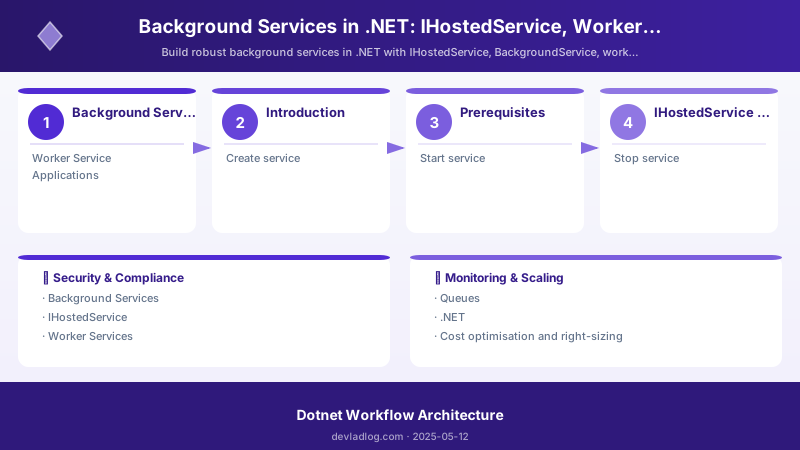
Figure: Program.cs – service registration with IntelliSense for DI lifetimes.
Creating a Worker
Project template:
dotnet new worker -n MyWorkerService
cd MyWorkerService
dotnet run
Expected output:
The template "ASP.NET Core Web API" was created successfully.
Restore succeeded.

Worker.cs:
public class Worker : BackgroundService
{
```csharp
private readonly ILogger<Worker> _logger;
private readonly IConfiguration _configuration;

public Worker(ILogger<Worker> logger, IConfiguration configuration)
{
    _logger = logger;
    _configuration = configuration;
}

protected override async Task ExecuteAsync(CancellationToken stoppingToken)
{
    var interval = _configuration.GetValue<int>("WorkerInterval", 60);

    while (!stoppingToken.IsCancellationRequested)
    {
        _logger.LogInformation("Worker running at: {time}", DateTimeOffset.Now);

        await DoWorkAsync(stoppingToken);

        await Task.Delay(TimeSpan.FromSeconds(interval), stoppingToken);
    }
}

private async Task DoWorkAsync(CancellationToken cancellationToken)
{
    // Your background work here
    await Task.Delay(1000, cancellationToken);
}```
}
Program.cs:
var builder = Host.CreateApplicationBuilder(args);

builder.Services.AddHostedService<Worker>();

// Add dependencies
builder.Services.AddScoped<IDataService, DataService>();
builder.Services.AddSingleton<IMessageQueue, RabbitMqQueue>();

// Configure logging
builder.Logging.AddConsole();
builder.Logging.AddEventLog();

var host = builder.Build();
await host.RunAsync();
Windows Service Deployment
Configuration:
<Project Sdk="Microsoft.NET.Sdk.Worker">
  <PropertyGroup>
```text
<TargetFramework>net8.0</TargetFramework>
<Nullable>enable</Nullable>
<ImplicitUsings>enable</ImplicitUsings>
<OutputType>exe</OutputType>```
  </PropertyGroup>

  <ItemGroup>
```text
<PackageReference Include="Microsoft.Extensions.Hosting" Version="8.0.0" />
<PackageReference Include="Microsoft.Extensions.Hosting.WindowsServices" Version="8.0.0" />```
  </ItemGroup>
</Project>
Enable Windows Service:
var builder = Host.CreateApplicationBuilder(args);

builder.Services.AddWindowsService(options =>
{
```text
options.ServiceName = "MyWorkerService";```
});

builder.Services.AddHostedService<Worker>();

var host = builder.Build();
await host.RunAsync();
Install service:
# Publish
dotnet publish -c Release -o C:\Services\MyWorkerService

## Create service
sc create MyWorkerService binPath="C:\Services\MyWorkerService\MyWorkerService.exe"

## Start service
sc start MyWorkerService


## Stop service
sc stop MyWorkerService


## Delete service
sc delete MyWorkerService
Expected output:
MyApp.Api -> /src/MyApp.Api/bin/Release/net8.0/publish/

Scheduled Tasks
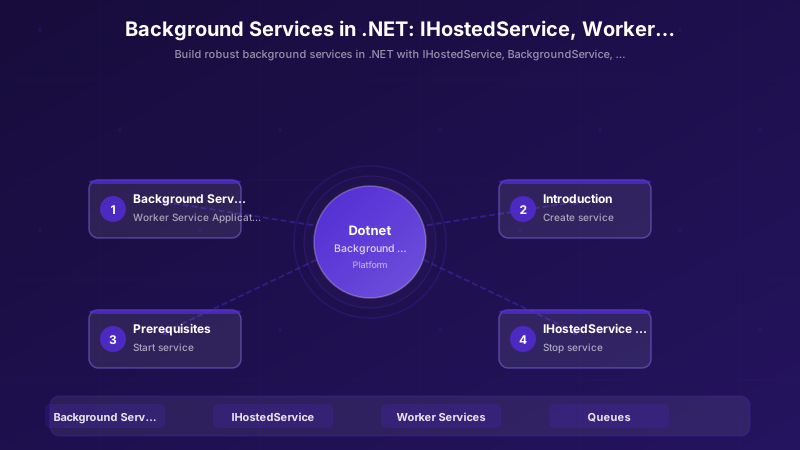
Figure: Scheduled flow – recurrence trigger with time zone options.
Quartz.NET Integration
Installation:
dotnet add package Quartz
dotnet add package Quartz.Extensions.Hosting
Configuration:
builder.Services.AddQuartz(q =>
{
```javascript
// Register jobs
q.AddJob<DataCleanupJob>(opts => opts.WithIdentity("DataCleanup"));
q.AddJob<ReportGenerationJob>(opts => opts.WithIdentity("ReportGeneration"));

// Trigger for data cleanup (daily at 2 AM)
q.AddTrigger(opts => opts
    .ForJob("DataCleanup")
    .WithIdentity("DataCleanup-trigger")
    .WithCronSchedule("0 0 2 * * ?"));

// Trigger for report generation (hourly)
q.AddTrigger(opts => opts
    .ForJob("ReportGeneration")
    .WithIdentity("ReportGeneration-trigger")
    .WithSimpleSchedule(x => x
        .WithIntervalInHours(1)
        .RepeatForever()));```
});

builder.Services.AddQuartzHostedService(options =>
{
```text
options.WaitForJobsToComplete = true;```
});
Job implementation:
public class DataCleanupJob : IJob
{
```csharp
private readonly ILogger<DataCleanupJob> _logger;
private readonly IServiceScopeFactory _scopeFactory;

public DataCleanupJob(
    ILogger<DataCleanupJob> logger,
    IServiceScopeFactory scopeFactory)
{
    _logger = logger;
    _scopeFactory = scopeFactory;
}


public async Task Execute(IJobExecutionContext context)
{
    _logger.LogInformation("Starting data cleanup job");

    using var scope = _scopeFactory.CreateScope();
    var repository = scope.ServiceProvider.GetRequiredService<IDataRepository>();

    var cutoffDate = DateTime.UtcNow.AddDays(-90);
    var deletedCount = await repository.DeleteOldRecordsAsync(cutoffDate);

    _logger.LogInformation(
        "Data cleanup completed. Deleted {Count} records",
        deletedCount);
}```
}
Hangfire Alternative
Installation:
dotnet add package Hangfire
dotnet add package Hangfire.SqlServer
Configuration:
builder.Services.AddHangfire(config =>
{
```text
config.UseSqlServerStorage(
    builder.Configuration.GetConnectionString("HangfireConnection"));```
});

builder.Services.AddHangfireServer();

var app = builder.Build();

app.UseHangfireDashboard("/hangfire", new DashboardOptions
{
```text
Authorization = new[] { new HangfireAuthorizationFilter() }```
});

// Schedule recurring jobs
RecurringJob.AddOrUpdate(
```javascript
"data-cleanup",
() => CleanupOldData(),
Cron.Daily(2));
RecurringJob.AddOrUpdate(
"send-reports",
() => SendDailyReports(),
Cron.Daily(9));
## Queue Processing with Channels

### Producer-Consumer Pattern

**Channel-based queue:**

```csharp
public interface IBackgroundTaskQueue
{
```text
ValueTask QueueAsync(Func<CancellationToken, ValueTask> workItem);
ValueTask<Func<CancellationToken, ValueTask>> DequeueAsync(CancellationToken cancellationToken);```
}

public class BackgroundTaskQueue : IBackgroundTaskQueue
{
```text
private readonly Channel<Func<CancellationToken, ValueTask>> _queue;

public BackgroundTaskQueue(int capacity = 100)
{
    var options = new BoundedChannelOptions(capacity)
    {
        FullMode = BoundedChannelFullMode.Wait
    };
    _queue = Channel.CreateBounded<Func<CancellationToken, ValueTask>>(options);
}

public async ValueTask QueueAsync(Func<CancellationToken, ValueTask> workItem)
{
    if (workItem is null)
        throw new ArgumentNullException(nameof(workItem));

    await _queue.Writer.WriteAsync(workItem);
}

public async ValueTask<Func<CancellationToken, ValueTask>> DequeueAsync(
    CancellationToken cancellationToken)
{
    return await _queue.Reader.ReadAsync(cancellationToken);
}```
}

// Registration
builder.Services.AddSingleton<IBackgroundTaskQueue, BackgroundTaskQueue>();
builder.Services.AddHostedService<QueueProcessorService>();
Queue processor:
public class QueueProcessorService : BackgroundService
{
```csharp
private readonly IBackgroundTaskQueue _taskQueue;
private readonly ILogger<QueueProcessorService> _logger;

public QueueProcessorService(
    IBackgroundTaskQueue taskQueue,
    ILogger<QueueProcessorService> logger)
{
    _taskQueue = taskQueue;
    _logger = logger;
}

protected override async Task ExecuteAsync(CancellationToken stoppingToken)
{
    _logger.LogInformation("Queue processor service is starting");

    await foreach (var workItem in GetWorkItemsAsync(stoppingToken))
    {
        try
        {
            await workItem(stoppingToken);
        }
        catch (Exception ex)
        {
            _logger.LogError(ex, "Error processing work item");
        }
    }
}

private async IAsyncEnumerable<Func<CancellationToken, ValueTask>> GetWorkItemsAsync(
    [EnumeratorCancellation] CancellationToken cancellationToken)
{
    while (!cancellationToken.IsCancellationRequested)
    {
        var workItem = await _taskQueue.DequeueAsync(cancellationToken);
        yield return workItem;
    }
}```
}
Usage in API:
[ApiController]
[Route("api/[controller]")]
public class OrdersController : ControllerBase
{
```csharp
private readonly IBackgroundTaskQueue _taskQueue;
private readonly IOrderService _orderService;

[HttpPost]
public async Task<IActionResult> CreateOrder(Order order)
{
    // Save order synchronously
    var created = await _orderService.CreateAsync(order);

    // Queue background tasks
    await _taskQueue.QueueAsync(async ct =>
    {
        await SendConfirmationEmailAsync(created.Id, ct);
    });

    await _taskQueue.QueueAsync(async ct =>
    {
        await UpdateInventoryAsync(created.Items, ct);
    });

    return CreatedAtAction(nameof(GetOrder), new { id = created.Id }, created);
}```
}
Message Queue Integration
RabbitMQ Consumer
Installation:
dotnet add package RabbitMQ.Client
Consumer service:
public class RabbitMqConsumerService : BackgroundService
{
```csharp
private readonly ILogger<RabbitMqConsumerService> _logger;
private readonly IServiceScopeFactory _scopeFactory;
private IConnection? _connection;
private IModel? _channel;

public RabbitMqConsumerService(
    ILogger<RabbitMqConsumerService> logger,
    IServiceScopeFactory scopeFactory)
{
    _logger = logger;
    _scopeFactory = scopeFactory;

    InitializeRabbitMQ();
}

private void InitializeRabbitMQ()
{
    var factory = new ConnectionFactory
    {
        HostName = "localhost",
        UserName = "guest",
        Password = "guest",
        DispatchConsumersAsync = true
    };

    _connection = factory.CreateConnection();
    _channel = _connection.CreateModel();

    _channel.QueueDeclare(
        queue: "orders",
        durable: true,
        exclusive: false,
        autoDelete: false);

    _channel.BasicQos(prefetchSize: 0, prefetchCount: 1, global: false);
}

protected override Task ExecuteAsync(CancellationToken stoppingToken)
{
    stoppingToken.Register(() => _logger.LogInformation("Consumer stopping"));

    var consumer = new AsyncEventingBasicConsumer(_channel);

    consumer.Received += async (model, ea) =>
    {
        try
        {
            var body = ea.Body.ToArray();
            var message = Encoding.UTF8.GetString(body);

            await ProcessMessageAsync(message, stoppingToken);

            _channel.BasicAck(ea.DeliveryTag, multiple: false);
        }
        catch (Exception ex)
        {
            _logger.LogError(ex, "Error processing message");
            _channel.BasicNack(ea.DeliveryTag, multiple: false, requeue: true);
        }
    };

    _channel.BasicConsume(
        queue: "orders",
        autoAck: false,
        consumer: consumer);

    return Task.CompletedTask;
}

private async Task ProcessMessageAsync(string message, CancellationToken cancellationToken)
{
    using var scope = _scopeFactory.CreateScope();
    var orderService = scope.ServiceProvider.GetRequiredService<IOrderService>();

    var order = JsonSerializer.Deserialize<Order>(message);
    await orderService.ProcessOrderAsync(order, cancellationToken);
}

public override void Dispose()
{
    _channel?.Close();
    _connection?.Close();
    base.Dispose();
}```
}
Azure Service Bus Integration
Installation:
dotnet add package Azure.Messaging.ServiceBus
Consumer service:
public class ServiceBusConsumerService : BackgroundService
{
```csharp
private readonly ILogger<ServiceBusConsumerService> _logger;
private readonly IServiceScopeFactory _scopeFactory;
private ServiceBusProcessor? _processor;

public ServiceBusConsumerService(
    ILogger<ServiceBusConsumerService> logger,
    IServiceScopeFactory scopeFactory,
    IConfiguration configuration)
{
    _logger = logger;
    _scopeFactory = scopeFactory;

    var connectionString = configuration["ServiceBus:ConnectionString"];
    var queueName = configuration["ServiceBus:QueueName"];

    var client = new ServiceBusClient(connectionString);
    _processor = client.CreateProcessor(queueName, new ServiceBusProcessorOptions
    {
        MaxConcurrentCalls = 10,
        AutoCompleteMessages = false
    });

    _processor.ProcessMessageAsync += ProcessMessageAsync;
    _processor.ProcessErrorAsync += ProcessErrorAsync;
}

protected override async Task ExecuteAsync(CancellationToken stoppingToken)
{
    await _processor!.StartProcessingAsync(stoppingToken);

    // Keep service running
    await Task.Delay(Timeout.Infinite, stoppingToken);
}

private async Task ProcessMessageAsync(ProcessMessageEventArgs args)
{
    using var scope = _scopeFactory.CreateScope();
    var orderService = scope.ServiceProvider.GetRequiredService<IOrderService>();

    var body = args.Message.Body.ToString();
    var order = JsonSerializer.Deserialize<Order>(body);

    await orderService.ProcessOrderAsync(order, args.CancellationToken);
    await args.CompleteMessageAsync(args.Message);
}

private Task ProcessErrorAsync(ProcessErrorEventArgs args)
{
    _logger.LogError(args.Exception, "Service Bus error");
    return Task.CompletedTask;
}

public override async Task StopAsync(CancellationToken cancellationToken)
{
    await _processor!.StopProcessingAsync(cancellationToken);
    await base.StopAsync(cancellationToken);
}```
}
Graceful Shutdown
Figure: Configuration and management dashboard with status overview.
Handling Cancellation
Proper cleanup:
public class LongRunningService : BackgroundService
{
```csharp
private readonly ILogger<LongRunningService> _logger;

protected override async Task ExecuteAsync(CancellationToken stoppingToken)
{
    try
    {
        while (!stoppingToken.IsCancellationRequested)
        {
            await ProcessBatchAsync(stoppingToken);
        }
    }
    catch (OperationCanceledException)
    {
        // Expected during shutdown
        _logger.LogInformation("Service is stopping gracefully");
    }
    finally
    {
        await CleanupResourcesAsync();
    }
}

private async Task ProcessBatchAsync(CancellationToken cancellationToken)
{
    // Pass cancellation token to all async operations
    await FetchDataAsync(cancellationToken);
    await ProcessDataAsync(cancellationToken);
    await SaveResultsAsync(cancellationToken);

    // Check cancellation before delays
    await Task.Delay(TimeSpan.FromMinutes(1), cancellationToken);
}

private async Task CleanupResourcesAsync()
{
    _logger.LogInformation("Cleaning up resources");
    // Close connections, flush buffers, etc.
}```
}
Shutdown Timeout
Configuration:
var builder = Host.CreateApplicationBuilder(args);

builder.Services.Configure<HostOptions>(options =>
{
```text
options.ShutdownTimeout = TimeSpan.FromSeconds(30);```
});

builder.Services.AddHostedService<Worker>();

var host = builder.Build();
await host.RunAsync();
Best Practices
- Use IServiceScopeFactory: Create scoped services in background tasks
- Handle Cancellation: Respect CancellationToken in all async operations
- Implement Idempotency: Handle duplicate message processing
- Add Retry Logic: Use Polly for transient failures
- Monitor Performance: Track queue depth and processing times
- Log Extensively: Background errors are easy to miss
- Test Shutdown: Ensure graceful cleanup under all conditions
Troubleshooting
Service Won't Stop:
// ❌ Ignores cancellation
while (true)
{
```text
await Task.Delay(1000);```
}

// ✅ Respects cancellation
while (!stoppingToken.IsCancellationRequested)
{
```text
await Task.Delay(1000, stoppingToken);```
}
Memory Leaks:
// ✅ Always dispose scopes
using var scope = _scopeFactory.CreateScope();
var service = scope.ServiceProvider.GetRequiredService<IService>();
// Scope disposed automatically
Architecture Decision and Tradeoffs
When designing application development solutions with .NET, consider these key architectural trade-offs:
| Approach | Best For | Tradeoff |
|---|---|---|
| Managed / platform service | Rapid delivery, reduced ops burden | Less customisation, potential vendor lock-in |
| Custom / self-hosted | Full control, advanced tuning | Higher operational overhead and cost |
Recommendation: Start with the managed approach for most workloads and move to custom only when specific requirements demand it.
Validation and Versioning
- Last validated: April 2026
- Validate examples against your tenant, region, and SKU constraints before production rollout.
- Keep module, CLI, and SDK versions pinned in automation pipelines and review quarterly.
Security and Governance Considerations
- Apply least-privilege access using RBAC roles and just-in-time elevation for admin tasks.
- Store secrets in managed secret stores and avoid embedding credentials in scripts or source files.
- Enable audit logging, data protection policies, and periodic access reviews for regulated workloads.
Cost and Performance Notes
- Define budgets and alerts, then monitor usage and cost trends continuously after go-live.
- Baseline performance with synthetic and real-user checks before and after major changes.
- Scale resources with measured thresholds and revisit sizing after usage pattern changes.
Official Microsoft References
- https://learn.microsoft.com/dotnet/
- https://learn.microsoft.com/aspnet/core/
- https://learn.microsoft.com/azure/developer/dotnet/
Public Examples from Official Sources
- These examples are sourced from official public Microsoft documentation and sample repositories.
- Documentation examples: https://learn.microsoft.com/dotnet/
- Sample repositories: https://github.com/dotnet/samples
- Prefer adapting these examples to your tenant, subscriptions, and governance requirements before production use.
Key Takeaways
- IHostedService and BackgroundService enable long-running background operations
- Worker services run as standalone applications or Windows Services
- Quartz.NET and Hangfire provide robust scheduling capabilities
- Channels enable efficient producer-consumer queue processing
- Graceful shutdown handling prevents data loss and resource leaks
Next Steps
- Implement health checks for background services
- Add distributed locking with Redis for multi-instance deployments
- Explore Akka.NET for actor-based processing
- Use Application Insights to monitor background job performance
Additional Resources
Background work, foreground results.
Discussion