
} ], max_tokens=500 )
return response.choices[0].message.content
# Example usage
result = analyze_image("chart.png", "Explain the trends shown in this chart")
print(result)
Document Analysis
Figure: SharePoint document library – metadata columns, views, and filter panel.
def extract_table_data(image_path):
```python
"""Extract structured data from table images"""
prompt = """```
Analyze this table image and extract the data in JSON format.
Structure: {"columns": [...], "rows": [[...], [...], ...]}
"""


```text
base64_image = encode_image(image_path)


response = client.chat.completions.create(
    model="gpt-4-vision",
    messages=[
        {
            "role": "user",
            "content": [
                {"type": "text", "text": prompt},
                {"type": "image_url", "image_url": {"url": f"data:image/jpeg;base64,{base64_image}"}}
            ]
        }
    ]
)

return json.loads(response.choices[0].message.content)
## DALL-E Image Generation

```python
def generate_image(prompt, size="1024x1024", quality="standard", n=1):
```python
"""Generate images from text descriptions"""
response = client.images.generate(
    model="dall-e-3",
    prompt=prompt,
    size=size,
    quality=quality,
    n=n
)


image_url = response.data[0].url
revised_prompt = response.data[0].revised_prompt

return {
    "url": image_url,
    "revised_prompt": revised_prompt
}
Example
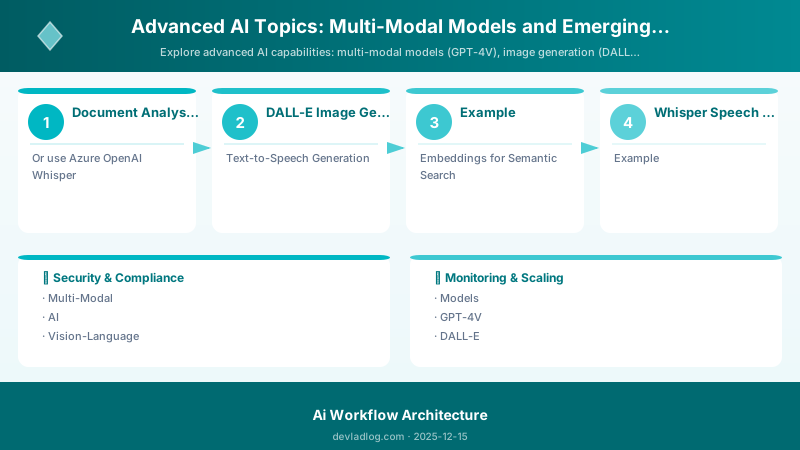
Figure: Configuration and management dashboard with status overview.
result = generate_image(
"A futuristic cityscape with flying cars and holographic billboards, cyberpunk style"```
)
Whisper Speech Recognition
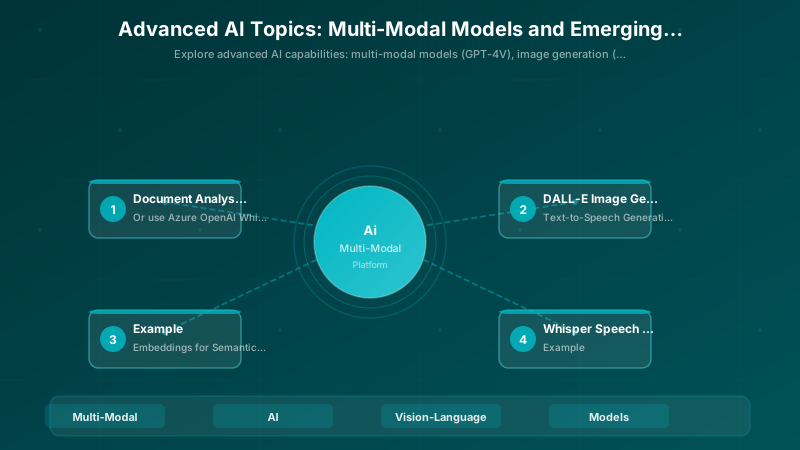
Figure: AI Services resource – deployed models and endpoint configuration.
from azure.cognitiveservices.speech import SpeechConfig, AudioConfig, SpeechRecognizer


def transcribe_audio(audio_file_path):
```text
"""Convert speech to text"""
speech_config = SpeechConfig(
    subscription="<key>",
    region="<region>"
)

audio_config = AudioConfig(filename=audio_file_path)
recognizer = SpeechRecognizer(speech_config=speech_config, audio_config=audio_config)

result = recognizer.recognize_once()
return result.text
Or use Azure OpenAI Whisper
Figure: Azure OpenAI Studio – chat playground with parameters and token usage.
def transcribe_with_whisper(audio_file_path):
with open(audio_file_path, "rb") as audio_file:
    transcript = client.audio.transcriptions.create(
        model="whisper",
        file=audio_file
    )


return transcript.text
## Text-to-Speech Generation

```python
from azure.cognitiveservices.speech import SpeechSynthesizer


def generate_speech(text, output_file="output.wav", voice="en-US-JennyNeural"):
```text
"""Convert text to natural speech"""
speech_config = SpeechConfig(subscription="<key>", region="<region>")
speech_config.speech_synthesis_voice_name = voice

audio_config = AudioConfig(filename=output_file)
synthesizer = SpeechSynthesizer(speech_config=speech_config, audio_config=audio_config)

result = synthesizer.speak_text_async(text).get()
return result.audio_duration
## Embeddings for Semantic Search

```python
from openai import AzureOpenAI
import numpy as np
from sklearn.metrics.pairwise import cosine_similarity


def get_embedding(text, model="text-embedding-ada-002"):
```text
"""Generate vector embedding for text"""
response = client.embeddings.create(
    input=text,
    model=model
)
return response.data[0].embedding
def semantic_search(query, documents):
"""Find most relevant documents using embeddings"""
query_embedding = get_embedding(query)
doc_embeddings = [get_embedding(doc) for doc in documents]

similarities = cosine_similarity([query_embedding], doc_embeddings)[0]

results = sorted(
    zip(documents, similarities),
    key=lambda x: x[1],
    reverse=True
)

return results
Example
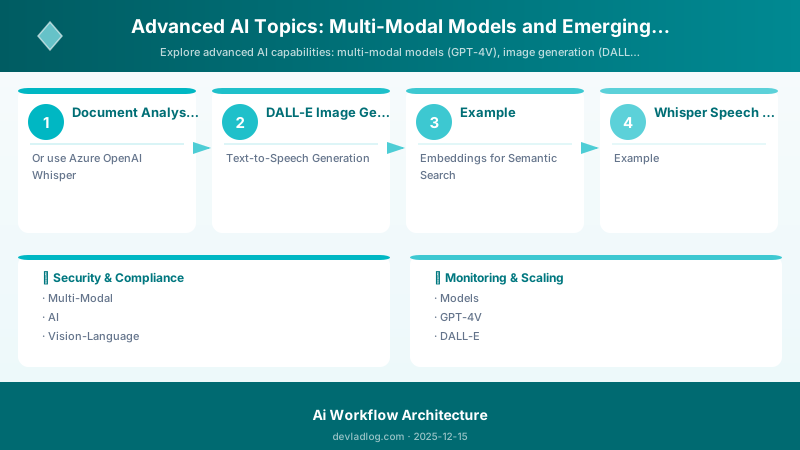
Figure: Configuration and management dashboard with status overview.
docs = [
"Azure Machine Learning provides MLOps capabilities",
"Python is a popular programming language",
"Cloud computing enables scalable infrastructure"```
]

results = semantic_search("How to deploy ML models?", docs)
for doc, score in results:
```text
print(f"{score:.3f}: {doc}")
## Fine-Tuning Custom Models

```python
from openai import AzureOpenAI


def prepare_training_data(examples):
```sql
"""Format training data for fine-tuning"""
training_data = []
for example in examples:
    training_data.append({
        "messages": [
            {"role": "system", "content": "You are a customer support assistant."},
            {"role": "user", "content": example["input"]},
            {"role": "assistant", "content": example["output"]}
        ]
    })

with open("training_data.jsonl", "w") as f:
    for item in training_data:
        f.write(json.dumps(item) + "\n")
def create_fine_tune_job(training_file_id):
"""Submit fine-tuning job"""
response = client.fine_tuning.jobs.create(
    training_file=training_file_id,
    model="gpt-35-turbo",
    hyperparameters={
        "n_epochs": 3,
        "batch_size": 1,
        "learning_rate_multiplier": 0.1
    }
)

return response.id
Upload training file
with open("training_data.jsonl", "rb") as f:
file_response = client.files.create(file=f, purpose="fine-tune")
Create fine-tune job
job_id = create_fine_tune_job(file_response.id)
## Multi-Agent Orchestration

```python
class AgentOrchestrator:
```python
"""Coordinate multiple specialized agents"""


def __init__(self):
    self.agents = {
        "researcher": self._create_agent("Research specialist"),
        "coder": self._create_agent("Expert programmer"),
        "writer": self._create_agent("Technical writer")
    }

def _create_agent(self, role):
    return lambda prompt: client.chat.completions.create(
        model="gpt-4",
        messages=[
            {"role": "system", "content": f"You are a {role}."},
            {"role": "user", "content": prompt}
        ]
    ).choices[0].message.content

def solve_complex_task(self, task):
    """Break down task and delegate to specialized agents"""

    # Research phase
    research = self.agents["researcher"](
        f"Research this topic: {task}"
    )

    # Code implementation
    code = self.agents["coder"](
        f"Based on this research, implement a solution:\n{research}"
    )

    # Documentation
    docs = self.agents["writer"](
        f"Document this code:\n{code}"
    )

    return {
        "research": research,
        "implementation": code,
        "documentation": docs
    }
## Emerging Capabilities

### Chain-of-Thought Reasoning


```python
def chain_of_thought_reasoning(problem):
```text
"""Use step-by-step reasoning for complex problems"""
prompt = f"""```
Solve this problem step by step. Show your reasoning at each step.

Problem: {problem}

Step 1: Understand the problem
Step 2: Identify relevant information
Step 3: Break down into sub-problems
Step 4: Solve each sub-problem
Step 5: Combine solutions
Final Answer:
"""

```text
response = client.chat.completions.create(
    model="gpt-4",
    messages=[{"role": "user", "content": prompt}],
    temperature=0.1
)

return response.choices[0].message.content
### Tree-of-Thought

```python
def tree_of_thought(problem, num_branches=3):
```text
"""Explore multiple reasoning paths"""
branches = []

for i in range(num_branches):
    prompt = f"""```
Generate reasoning path #{i+1} for this problem:
{problem}

Think creatively and explore different approaches.
"""

        response = client.chat.completions.create(
            model="gpt-4",
            messages=[{"role": "user", "content": prompt}],
            temperature=0.8
        )

        branches.append(response.choices[0].message.content)

```text
## Evaluate branches
evaluation_prompt = f"""```
Problem: {problem}


Reasoning paths:
{chr(10).join([f"{i+1}. {branch}" for i, branch in enumerate(branches)])}

Which reasoning path is most sound? Explain and provide final answer.
"""

```text
final_response = client.chat.completions.create(
    model="gpt-4",
    messages=[{"role": "user", "content": evaluation_prompt}]
)

return final_response.choices[0].message.content
## Best Practices

- Combine modalities for richer applications
- Validate generated content before use
- Implement fallback mechanisms
- Monitor usage and costs across services
- Cache embeddings for repeated queries
- Use appropriate models for each task
- Test extensively with edge cases
- Implement safety filters for all outputs


## Future Trends

- **Multimodal Foundation Models**: Unified models for all modalities
- **Autonomous Agents**: Self-directed task completion
- **Continuous Learning**: Models that adapt without retraining
- **Smaller, Efficient Models**: Edge deployment capabilities
- **Enhanced Reasoning**: Improved logical and mathematical capabilities


## Troubleshooting

| Issue | Cause | Resolution |
|-------|-------|------------|
| Vision API errors | Unsupported image format | Convert to JPEG/PNG; check size limits |
| Poor image quality | Low resolution input | Use higher resolution; enhance preprocessing |
| Embedding drift | Model version change | Re-embed all documents with same model |
| High latency | Large multi-modal inputs | Compress images; optimize requests |


## Architecture Decision and Tradeoffs

When designing AI/ML solutions with Azure AI Services, consider these key architectural trade-offs:

| Approach | Best For | Tradeoff |
|----------|----------|----------|
| Managed / platform service | Rapid delivery, reduced ops burden | Less customisation, potential vendor lock-in |
| Custom / self-hosted | Full control, advanced tuning | Higher operational overhead and cost |

> **Recommendation:** Start with the managed approach for most workloads and move to custom only when specific requirements demand it.

## Validation and Versioning

- Last validated: April 2026
- Validate examples against your tenant, region, and SKU constraints before production rollout.
- Keep module, CLI, and SDK versions pinned in automation pipelines and review quarterly.

## Security and Governance Considerations

- Apply least-privilege access using RBAC roles and just-in-time elevation for admin tasks.
- Store secrets in managed secret stores and avoid embedding credentials in scripts or source files.
- Enable audit logging, data protection policies, and periodic access reviews for regulated workloads.

## Cost and Performance Notes

- Define budgets and alerts, then monitor usage and cost trends continuously after go-live.
- Baseline performance with synthetic and real-user checks before and after major changes.
- Scale resources with measured thresholds and revisit sizing after usage pattern changes.

## Official Microsoft References

- https://learn.microsoft.com/azure/ai-services/
- https://learn.microsoft.com/azure/machine-learning/
- https://learn.microsoft.com/azure/ai-foundry/

## Public Examples from Official Sources

- These examples are sourced from official public Microsoft documentation and sample repositories.
- Documentation examples: https://learn.microsoft.com/azure/ai-services/
- Sample repositories: https://github.com/Azure-Samples?tab=repositories&q=ai&type=&language=&sort=
- Prefer adapting these examples to your tenant, subscriptions, and governance requirements before production use.

## Key Takeaways

Advanced AI combines multiple modalities, specialized models, and sophisticated orchestration patterns to solve complex, real-world problems.


## References

- https://learn.microsoft.com/azure/ai-services/openai/concepts/models
- https://learn.microsoft.com/azure/ai-services/speech-service/
Discussion