
def update(self, value): self.window.append(value) # Simplified cut logic if len(self.window) > 50: left = self.window[:len(self.window)//2] right = self.window[len(self.window)//2:] if abs(sum(left)/len(left) - sum(right)/len(right)) > self.delta: self.window = right # Drift found, shrink window return True return False
Page-Hinkley (Mean Shift)
class PageHinkley:
```python
def __init__(self, threshold=5, alpha=0.999):
    self.mean = 0.0
    self.cumulative = 0.0
    self.threshold = threshold
    self.alpha = alpha
def update(self, x):
    self.mean = self.alpha * self.mean + (1 - self.alpha) * x
    self.cumulative += x - self.mean
    if self.cumulative > self.threshold:
        self.cumulative = 0
        return True
    return False
## Embedding Drift (Text & Image)

Use cosine similarity between baseline and recent embedding centroids.


```python
import numpy as np

def embedding_drift(baseline_vecs, current_vecs):
```text
base_centroid = baseline_vecs.mean(axis=0)
curr_centroid = current_vecs.mean(axis=0)
cos = np.dot(base_centroid, curr_centroid) / (
    np.linalg.norm(base_centroid) * np.linalg.norm(curr_centroid)
)
return 1 - cos  # Larger value = more drift
## Drift Scoring Aggregation

Combine multiple signals into composite risk score.


```python
def composite_score(metrics):
```text
# metrics = {"psi_income":0.12, "ks_credit":0.09, "perf_delta":-0.02, "embed_drift":0.15}
weights = {"psi_income":0.3, "ks_credit":0.2, "perf_delta":0.3, "embed_drift":0.2}
score = 0.0
for k,v in metrics.items():
    score += weights.get(k,0) * v
return score
## Threshold Calibration Strategy

1. Collect 30–60 days of baseline distributions & performance.
2. Compute initial test statistics (PSI, KS, KL) for stable periods.
3. Set thresholds at mean + (2 * std) for each metric.
4. Review business impact of borderline cases; adjust with domain input.
5. Implement adaptive scaling: if weekly false positives > 5, relax threshold 10%; if misses occur (late detection), tighten 10%.


## Alerting & Severity Classification

| Severity | Condition | Example | Action |
|----------|-----------|---------|--------|
| Low | PSI 0.1–0.2 | Gradual demographic shift | Monitor trend |
| Medium | PSI > 0.2 or perf -2% | Feature distribution shift | Prepare retraining |
| High | PSI > 0.3 or perf -5% | Sudden upstream change | Immediate retrain + canary |
| Critical | Multiple metrics breach + fairness regression | Pipeline defect | Rollback + incident |


## Mitigation Workflow

1. Detect drift signal (automated metric job).
2. Classify severity (rules table).
3. Pull recent labeled window; generate candidate retrain.
4. Evaluate candidate vs champion (accuracy, fairness, latency).
5. If candidate passes gates → deploy canary; else escalate to data engineering.
6. Post-deployment monitor early metrics 24h.


## Azure Monitoring Integration (Concept)

- Log metrics to Azure Application Insights / CustomMetrics table.
- Scheduled Azure ML job computes PSI & KS and writes results.
- Alerts configured in Azure Monitor (static thresholds + dynamic anomaly detection).
- Event Grid trigger on high severity creates retraining pipeline schedule.


## KPIs

| KPI | Definition | Target |
|-----|------------|--------|
| Drift Detection Latency | Time from drift occurrence → alert | < 2h |
| False Positive Rate | Alerts with no performance impact | < 10% |
| Mitigation Lead Time | Alert → canary deploy | < 8h |
| Performance Recovery | Time to restore baseline accuracy | < 24h |
| Fairness Stability | Parity diff change post-mitigation | ≤ 0.02 |


## Early Performance Degradation Detection

Track rolling degradation slope for proactive action.


```python
def performance_slope(window_metrics):
```python
## window_metrics: list of (timestamp, accuracy)
import numpy as np
ys = np.array([m[1] for m in window_metrics])
xs = np.arange(len(ys))
slope = np.polyfit(xs, ys, 1)[0]
return slope
## Best Practices

- Use multiple tests (PSI + KS + performance) to reduce false positives.
- Separate detection (signal) from decision (action gating).
- Store drift artifacts (metrics JSON, sample slices) for audit.
- Include fairness metrics alongside drift to avoid biased retraining.
- Automate periodic recalibration of thresholds.
- Monitor upstream data pipeline schema changes.


## FAQs

| Question | Answer |
|----------|--------|
| Why not rely only on accuracy? | Accuracy lags underlying distribution changes; early tests detect sooner. |
| How often recalibrate thresholds? | Quarterly or after major data distribution shifts. |
| Can drift be positive? | Yes—new patterns may improve performance; still validate stability. |
| What if labels delayed? | Use proxy metrics (confidence entropy) until labels arrive. |
| How handle multi-modal drift? | Run separate tests per modality + embedding similarity fusion. |


## Next Steps

- Implement scheduled drift job.
- Integrate composite score into monitoring dashboard.
- Add retraining trigger annotations (reason codes) to lineage.


## References

- Kolmogorov–Smirnov Test (Scipy)
- Population Stability Index (Industry best practice)
- KL Divergence for distribution distance
- ADWIN / Page-Hinkley streaming drift algorithms
- Azure Monitor Custom Metrics Documentation


## Advanced Detection Algorithms

### Drift Detection Method (DDM)


```python
class DDM:
```python
def __init__(self, warning_level=2.0, drift_level=3.0):
    self.n = 0
    self.error_rate = 0.0
    self.std = 0.0
    self.min_rate = float('inf')
    self.min_std = float('inf')
    self.warning_level = warning_level
    self.drift_level = drift_level
def update(self, error):  # error = 1 if misclassification else 0
    self.n += 1
    self.error_rate = self.error_rate + (error - self.error_rate) / self.n
    self.std = (self.error_rate * (1 - self.error_rate) / self.n) ** 0.5
    if self.error_rate + self.std < self.min_rate + self.min_std:
        self.min_rate = self.error_rate
        self.min_std = self.std
    p = self.error_rate + self.std
    p_min = self.min_rate + self.min_std
    if p > p_min + self.drift_level * self.min_std:
        return "drift"
    if p > p_min + self.warning_level * self.min_std:
        return "warning"
    return None
### Early Drift Detection Method (EDDM)

Improves sensitivity for gradual drift by tracking distance between errors.

```python
class EDDM:
```python
def __init__(self, warning=0.95, drift=0.9, min_errors=30):
    self.warning = warning
    self.drift = drift
    self.min_errors = min_errors
    self.prev_error_pos = 0
    self.distances = []
    self.pos = 0
def update(self, error):
    self.pos += 1
    if error:
        if self.prev_error_pos != 0:
            self.distances.append(self.pos - self.prev_error_pos)
        self.prev_error_pos = self.pos
    if len(self.distances) < self.min_errors:
        return None
    mean = sum(self.distances) / len(self.distances)
    norm = (self.pos - self.prev_error_pos) / mean if mean else 0
    if norm < self.drift:
        return "drift"
    if norm < self.warning:
        return "warning"
    return None
## Image & Vision Drift (Fréchet Inception Distance)

```python
def fid(mu1, sigma1, mu2, sigma2):
```python
import numpy as np
from scipy.linalg import sqrtm
diff = mu1 - mu2
covmean = sqrtm(sigma1.dot(sigma2))
if np.iscomplexobj(covmean):
    covmean = covmean.real
return diff.dot(diff) + np.trace(sigma1 + sigma2 - 2 * covmean)
Apply FID between historical image embedding distribution and recent batch to quantify shift in visual domain.

## Confidence Entropy Monitoring

```python
import numpy as np
def prediction_entropy(proba):
```text
return -np.sum(proba * np.log(proba + 1e-9))
def batch_entropy(probas):
return float(np.mean([prediction_entropy(p) for p in probas]))
Rising entropy signals model uncertainty potentially linked to concept drift before accuracy declines (labels delayed scenarios).

## Multi-Modal Drift Fusion

Aggregate modality-specific scores (text embedding shift, image FID, tabular PSI) into unified risk index.


```python
def multimodal_risk(scores):
```text
## scores: {"text_embed":0.12, "image_fid":34.2, "tabular_psi":0.18}
weights = {"text_embed":0.25, "image_fid":0.4, "tabular_psi":0.35}
norm = {
  "text_embed": scores["text_embed"],
  "image_fid": min(scores["image_fid"] / 50.0, 1.0),
  "tabular_psi": min(scores["tabular_psi"] / 0.3, 1.0)
}
return sum(weights[k] * norm[k] for k in weights)
## Fairness Under Drift

Drift can disproportionately affect subgroups. Track parity metrics conditioned on drift events.


```python
def subgroup_disparity(preds, labels, subgroup):
```python
import numpy as np
mask = subgroup == 1
acc_sub = (preds[mask] == labels[mask]).mean()
acc_all = (preds == labels).mean()
return acc_sub - acc_all
Integrate disparity deltas into retraining gating to avoid amplifying bias when distributions shift.

## Detection Pipeline (Azure ML Scheduled Job)

```yaml


## drift-job.yml
type: pipeline
settings:
  default_compute: cpu-cluster
jobs:
  drift_compute:
```python
type: command
code: ./drift
command: >-
  python run_drift.py --baseline ${{inputs.baseline}} --current ${{inputs.current}}
inputs:
  baseline:
    type: uri_folder
    path: azureml://datastores/workspaceblobstore/paths/baseline/


  current:
    type: uri_folder
    path: azureml://datastores/workspaceblobstore/paths/current/
outputs:
  report:
    type: uri_file
Schedule via cron; parse report and emit CustomMetric entries with severity classification.


## Data Slicing & Segment Analysis

Granular drift detection improves resolution (e.g., income bracket 40–60k).


```python
def slice_stats(df, column, bins):
```python
import numpy as np
results = []
for i in range(len(bins)-1):
    segment = df[(df[column] >= bins[i]) & (df[column] < bins[i+1])]
    results.append({"range": f"{bins[i]}-{bins[i+1]}", "count": len(segment)})
return results
Use slice-level PSI to localize problematic shifts before global metrics trigger.

## Simulation Harness (Synthetic Drift Injection)

```python
def inject_shift(df, column, factor=1.2):
```text
shifted = df.copy()
shifted[column] = shifted[column] * factor
return shifted
def evaluate_detection(detector, baseline, factor_values):
results = []
for f in factor_values:
    current = inject_shift(baseline, 'income', f)
    score = psi(baseline['income'], current['income'])


    results.append((f, score))
return results
Simulation quantifies sensitivity and helps calibrate thresholds realistically.

## Retraining Decision Matrix

| Scenario | Metrics | Action | Justification |
|----------|---------|--------|---------------|
| Mild drift, stable performance | PSI < 0.15, perf delta > -1% | Monitor | Avoid unnecessary cost |
| Moderate drift, small perf drop | PSI 0.15–0.25, perf delta -2% | Prep retrain candidate | Preempt further decay |
| Severe drift, perf decline | PSI > 0.25, perf delta -4% | Immediate retrain + canary | Prevent business impact |
| Fairness regression | Parity diff > 0.08 | Bias-aware retrain | Mitigate ethical risk |


## Maturity Model (Drift Capability)

| Level | Description | Focus |
|-------|-------------|-------|
| 1 Reactive | Manual detection after complaints | Instrument metrics |
| 2 Basic | Scheduled PSI + performance alerts | Add streaming tests |
| 3 Proactive | Composite risk scoring + severity | Integrate fairness & slicing |
| 4 Adaptive | Dynamic threshold tuning | Automate retrain gating |
| 5 Intelligent | Self-calibrating triggers + root cause mapping | Optimize cost & precision |
| 6 Autonomous | Closed-loop retraining + continuous validation | Strategic exception handling |


## KPI Catalog (Extended)

| KPI | Target | Rationale |
|-----|--------|-----------|
| False Negative Drift Rate | < 5% | Ensure early detection |
| Slice Coverage | > 90% key segments monitored | Equity & granularity |
| Threshold Recalibration Interval | ≤ 90 days | Maintain relevance |
| Auto-Retrain Acceptance Rate | > 70% candidates promoted | Efficiency of triggers |
| Detection Cost per Month | Trending stable or ↓ | Optimize resource usage |


## Troubleshooting

| Issue | Cause | Resolution | Prevention |
|-------|-------|-----------|------------|
| Frequent false positives | Threshold too tight | Relax thresholds 10% | Adaptive calibration routine |
| Missed severe drift | Insufficient metrics | Add embedding + entropy | Expand metric suite |
| High retrain cost | Over-triggering | Composite scoring to gate | Cost-aware policy |
| Fairness worsens post retrain | Data imbalance | Reweight / sample balancing | Fairness metric gating |
| Vision drift undetected | Missing image metric | Add FID test | Multimodal checklist |
| Delayed detection (labels) | Label lag | Use entropy proxies | Near-real-time proxy pipeline |


## Best Practices & Anti-Patterns

| Best Practice | Benefit | Anti-Pattern | Risk |
|---------------|---------|-------------|------|
| Combine multiple metrics | Robust detection | Single test reliance | Blind spots |
| Calibrate thresholds with simulation | Realistic bounds | Arbitrary static thresholds | High noise |
| Include subgroup fairness tracking | Prevent hidden bias | Ignore subgroup shifts | Regulatory exposure |
| Automate retrain gating | Speed & consistency | Manual ad-hoc decisions | Latency & variability |
| Store drift artifacts | Audit trail | Ephemeral metrics only | Non-repeatable analysis |


## Azure Resource Provisioning (Bicep Snippet)

```bicep
resource driftLog 'Microsoft.Insights/components@2020-02-02' = {
  name: 'drift-ai-appinsights'
  location: resourceGroup().location
  kind: 'web'
  properties: {
```yaml
Application_Type: 'web'```
  }
}
Governance Alignment
- Log reason codes ("drift", "performance", "fairness") in lineage metadata.
- Include drift events in model card revision history.
- Maintain audit queries for regulator access (data distribution, severity timeline).
Incident Template (Drift Event)
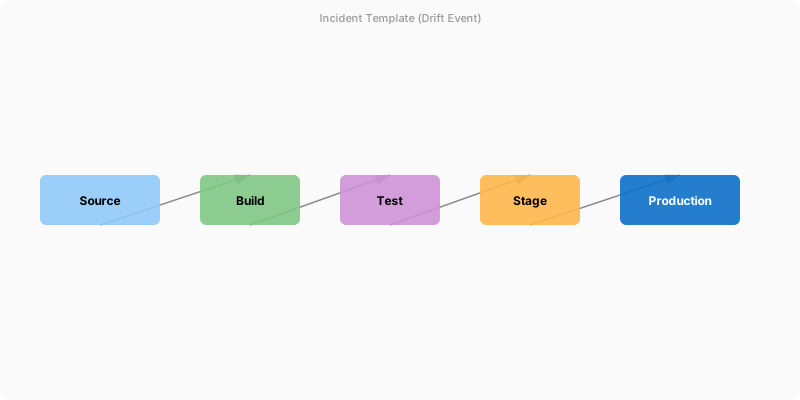
Figure: Prompt workspace – system message, examples, and completion preview.
Incident: Severe Data Drift (Income Feature)
Detected: 2025-11-24T10:25Z
Metrics: PSI=0.28, Perf Delta=-3.5%, Parity Diff +0.03
Action: Retrain candidate launched, canary scheduled
Follow-Up: Threshold recalibration, add additional slicing
Root Cause: Upstream ETL change (currency normalization error)
Cost & Performance Optimization
- Batch drift computations (group features) to reduce resource overhead.
- Use approximate quantiles for large datasets.
- Archive old drift reports to cold storage.
- Stream incremental stats rather than recomputing full distributions.
Final Summary
Robust drift detection weaves together statistical, streaming, and semantic signals—enforcing a disciplined cycle that preserves model relevance, fairness, and business value while minimizing unnecessary retraining cost.
Mathematical Foundations (Overview)
- KS Test: Non-parametric test comparing empirical CDFs; sensitive to location & shape changes.
- PSI: Measures shift in binned proportions; interpretable for business stakeholders; high bins needed for resolution but risk sparsity.
- KL Divergence: Asymmetric measure of information loss; sensitive to zero probabilities (apply smoothing).
- Jensen–Shannon Divergence: Symmetric, bounded variant; useful for stable thresholding.
Jensen–Shannon Divergence Example
import numpy as np
from scipy.spatial.distance import jensenshannon

def js_divergence(p, q, bins=20):
```text
hist_p, _ = np.histogram(p, bins=bins, density=True)
hist_q, _ = np.histogram(q, bins=bins, density=True)
return float(jensenshannon(hist_p + 1e-9, hist_q + 1e-9))
## Streaming Architecture (Real-Time Drift)

```text
Event Source → Stream Processor (Flink/Kafka) → Sliding Window Stats → Drift Evaluator → Alert Dispatcher → Retrain Orchestrator
Key design: maintain rolling histograms & performance counters; update metrics incrementally without full recomputation.
Incremental Histogram Update
Figure: WSUS console – update approvals, computer groups, and sync status.
class RollingHistogram:
```python
def __init__(self, bins):
    self.bins = bins
    self.counts = [0]* (len(bins)-1)
    self.total = 0
def add(self, value):
    for i in range(len(self.bins)-1):
        if self.bins[i] <= value < self.bins[i+1]:
            self.counts[i] += 1
            break
    self.total += 1


def distribution(self):
    return [c / self.total for c in self.counts]
## Concept Drift Adaptation Strategies

| Strategy | Mechanism | Pros | Cons |
|----------|-----------|------|------|
| Sliding Window Retrain | Keep last N samples | Fast adaptation | Possible forgetting |
| Weighted Decay | Exponential weighting of recent data | Smooth transition | Needs parameter tuning |
| Ensemble Incremental | Add learners, retire stale | Robust to abrupt changes | Complexity & cost |
| Meta-Learning Gate | Detect shift then switch model | Controlled adaptation | Detection latency risk |


### Weighted Sample Update

```python
def update_weighted_mean(prev_mean, x, alpha=0.9):
```text
return alpha * prev_mean + (1 - alpha) * x
## Azure Event Grid Trigger (High Severity Drift)

```python
import json, requests


def publish_drift_event(topic_endpoint, key, payload):
```text
headers = {"aeg-sas-key": key, "Content-Type": "application/json"}
event = [{
    "id": payload.get("id","drift-event"),
    "eventType": "Drift.HighSeverity",
    "subject": "ml/models/credit-risk",
    "data": payload,
    "dataVersion": "1.0"
}]
requests.post(topic_endpoint, headers=headers, data=json.dumps(event))
Architecture Overview: ## Service Level Objectives (Drift Management)
def evaluate_detector(detector, scenarios):
tp=fp=fn=0
for data, label in scenarios:  # label = True if drift
    result = detector(data)
    if result and label: tp += 1
    elif result and not label: fp += 1
    elif not result and label: fn += 1
precision = tp / (tp + fp + 1e-9)
recall = tp / (tp + fn + 1e-9)
return {"precision": precision, "recall": recall}
Benchmark detectors quarterly; deprecate underperforming ones.

## Data Quality Interplay

Differentiate drift vs data quality issues (missing values spike). Integrate quality checks preceding drift computation to avoid false positives.


## Fairness Remediation Patterns

| Pattern | Application | Trade-Off |
|---------|-------------|-----------|
| Reweighting | Adjust sample weights post drift | Potential variance increase |
| Constraint Optimization | Enforce parity during retrain | Slight accuracy reduction |
| Feature Auditing | Remove drift-prone biased features | Information loss risk |


## Rollback Strategy Under Drift

1. Detect severe drift impacting accuracy.
2. If candidate retrain fails fairness gate, rollback to previous champion.
3. Apply targeted feature recalibration (e.g., scaling update) and reattempt.
4. Escalate if repeat failure > 2 cycles.


## Privacy Considerations

- Avoid storing raw personally identifiable distributions; store aggregated stats only.
- Apply differential privacy noise to distribution summaries when exporting.


### Differential Privacy Noise Example

```python
import numpy as np
def dp_noisy_count(count, epsilon=1.0):
```text
noise = np.random.laplace(0, 1/epsilon)
return int(round(count + noise))
## Tooling Comparison

| Tool | Focus | Strength | Limitation |
|------|-------|----------|------------|
| River | Streaming ML & drift | Incremental algorithms | Smaller ecosystem |
| Alibi Detect | ML drift & outlier | Rich detectors (KS, MMD, etc.) | Extra infra overhead |
| Evidently | Reports & metrics | Comprehensive dashboards | Batch orientation |
| Custom (This Blueprint) | Tailored + integrated | Fine-grained governance | Higher build effort |


## Case Study (Credit Risk Model)

| Phase | Observation | Action | Outcome |
|-------|------------|--------|---------|
| Detection | PSI income=0.27, entropy +15% | Trigger retrain | Candidate built in 3h |
| Evaluation | Accuracy -1%, fairness stable | Promote canary | Canary live 10% traffic |
| Monitoring | Canary performs +1.5% accuracy | Full promotion | Performance restored |
| Postmortem | Upstream ETL currency bug | Patch pipeline | Threshold unchanged |


## Experimentation Framework

- Maintain scenario library (synthetic shifts: scaling, noise, distribution swaps).
- Score detectors (precision, recall, latency) across scenarios.
- Track detector drift (!) performance decay; rotate algorithms if necessary.


## Extended References

- River (Streaming ML) Documentation
- Alibi Detect (Open-source drift detection)
- Evidently AI (Monitoring & data drift reports)
- Jensen–Shannon Divergence Theory
- Differential Privacy (Laplace Mechanism)


## Azure Monitor Query Examples

### Drift Metric Time Series (KQL)


```kql
CustomMetrics
| where MetricName startswith "psi_" or MetricName startswith "embed_drift"
| summarize avg(MetricValue) by MetricName, bin(TimeGenerated, 1h)
| render timechart
Entropy & Performance Correlation
let entropy=CustomMetrics | where MetricName == "prediction_entropy" | project TimeGenerated, entropy=MetricValue;
let accuracy=CustomMetrics | where MetricName == "accuracy" | project TimeGenerated, accuracy=MetricValue;
entropy
| join kind=inner accuracy on TimeGenerated
| summarize avg(entropy), avg(accuracy)
Dashboard Design Considerations
| Panel | Content | Purpose |
|---|---|---|
| Summary | Current severity level | At-a-glance risk |
| Drift Signals | PSI / KS / KL / Entropy charts | Trend visualization |
| Fairness | Parity diff per subgroup | Equity monitoring |
| Performance | Accuracy, latency, error rate | Health context |
| History | Incident timeline | Root cause traceability |
| Actions | Pending retrain tasks | Operational follow-up |
Model Registry Integration
Embed drift metadata (last_drift_score, severity_level, retrain_reason) into model version tags for lineage.
tags = {
  "last_drift_score": 0.23,
  "severity_level": "medium",
  "retrain_reason": "psi_income>0.2"
}
ml_client.models.update(model_name, version, tags=tags)
Seasonal & Cyclical Adjustment
Use decomposition to differentiate seasonal pattern vs structural drift.
from statsmodels.tsa.seasonal import seasonal_decompose

def seasonal_residual(series):
```text
result = seasonal_decompose(series, model='additive', period=7)
return result.resid  # Compare residual shift vs baseline
Residual analysis reduces false positives in cases like predictable weekly traffic oscillation.

## Forecast-Based Drift Anticipation

Use Prophet or ARIMA to forecast expected distribution parameters; flag deviation outside prediction intervals.


```python
from prophet import Prophet
import pandas as pd

def forecast_stat(df):
```text
## df: columns ds (timestamp), y (mean income)
m = Prophet()
m.fit(df)
future = m.make_future_dataframe(periods=24, freq='H')
forecast = m.predict(future)
return forecast[['ds','yhat','yhat_lower','yhat_upper']]
## Cost Management for Drift Infrastructure

| Cost Driver | Optimization | Impact |
|-------------|--------------|--------|
| Frequent full scans | Incremental window stats | Lower compute usage |
| High cardinality slicing | Prioritized slice selection | Focus critical segments |
| Large embedding storage | Centroid retention only | Reduced storage |
| Retrain storms | Backoff + gate consolidation | Avoid redundant runs |


## KPI Automation Script (Excerpt)

```python
def publish_kpi(kusto_client, kpi_name, value):
```text


## pseudo: send to ingestion endpoint
payload = {"MetricName": kpi_name, "MetricValue": value}
kusto_client.ingest(payload)
Schedule daily KPI aggregation job; compare vs SLO thresholds; open incident if breach persists > 2 intervals.

## Future Roadmap

- Integrate causal analysis to differentiate upstream source from random variance.
- Add reinforcement learning for adaptive threshold tuning.
- Incorporate counterfactual fairness re-evaluation post drift.
- Expand multi-modal support (audio, sensor streams).
- Implement graph-based drift for relationship/structure changes.


## Extended FAQ Additions

| Question | Answer |
|----------|--------|
| How to prevent threshold overfitting? | Use hold-out period & periodic blind evaluation scenarios. |
| What if detectors disagree? | Apply ensemble voting; escalate on high-severity composite score. |
| Can we skip retrain if minor drift? | Yes—risk-based gating; track cumulative drift debt. |
| How to quantify business impact? | Map performance delta to revenue/operations KPI via attribution model. |
| What about label scarcity? | Semi-supervised drift + active learning query strategy. |


## Active Learning Strategy (Label Scarcity)

```python
def uncertainty_sampling(probas, k=100):
```python
import numpy as np
ent = [prediction_entropy(p) for p in probas]
idx = np.argsort(ent)[-k:]
return idx
Select top uncertainty samples for expedited labeling to accelerate concept drift validation.

## Governance Metrics & Audit Queries

Track governance impact of drift handling decisions (retrain reasons, fairness outcomes) with structured queries.


### KQL: Drift Event Timeline

```kql
CustomEvents
| where name == "drift_event"
| project timestamp, severity=customDimensions.Severity, feature=customDimensions.Feature, psi=customDimensions.PSI, action=customDimensions.Action
| order by timestamp desc
Governance Table
| Metric | Definition | Purpose |
|---|---|---|
| Retrain Reason Code Coverage | % retrains with reason logged | Audit completeness |
| Fairness Post-Drift Review Count | Reviews executed per quarter | Oversight enforcement |
| Drift Incident Closure SLA | Avg time to close incident | Operational efficiency |
| Threshold Change Audit Trail | % changes documented | Policy compliance |
Consistent governance metrics ensure transparency and regulatory readiness while enabling continuous improvement loops.
Architecture Decision and Tradeoffs
When designing AI/ML solutions with Azure AI Services, consider these key architectural trade-offs:
| Approach | Best For | Tradeoff |
|---|---|---|
| Managed / platform service | Rapid delivery, reduced ops burden | Less customisation, potential vendor lock-in |
| Custom / self-hosted | Full control, advanced tuning | Higher operational overhead and cost |
Recommendation: Start with the managed approach for most workloads and move to custom only when specific requirements demand it.
Validation and Versioning
- Last validated: April 2026
- Validate examples against your tenant, region, and SKU constraints before production rollout.
- Keep module, CLI, and SDK versions pinned in automation pipelines and review quarterly.
Security and Governance Considerations
- Apply least-privilege access using RBAC roles and just-in-time elevation for admin tasks.
- Store secrets in managed secret stores and avoid embedding credentials in scripts or source files.
- Enable audit logging, data protection policies, and periodic access reviews for regulated workloads.
Cost and Performance Notes
- Define budgets and alerts, then monitor usage and cost trends continuously after go-live.
- Baseline performance with synthetic and real-user checks before and after major changes.
- Scale resources with measured thresholds and revisit sizing after usage pattern changes.
Official Microsoft References
- https://learn.microsoft.com/azure/ai-services/
- https://learn.microsoft.com/azure/machine-learning/
- https://learn.microsoft.com/azure/ai-foundry/
Public Examples from Official Sources
- These examples are sourced from official public Microsoft documentation and sample repositories.
- Documentation examples: https://learn.microsoft.com/azure/ai-services/
- Sample repositories: https://github.com/Azure-Samples?tab=repositories&q=ai&type=&language=&sort=
- Prefer adapting these examples to your tenant, subscriptions, and governance requirements before production use.
Conclusion
An enterprise-grade drift program layers statistical rigor, streaming adaptivity, multimodal awareness, fairness safeguards, and governance instrumentation—delivering resilient models that evolve responsibly with changing data landscapes while preserving trust and business value.
Discussion