
MLOps: Machine Learning Operations and Pipelines
if event["eventType"] == "Microsoft.Storage.BlobCreated": # Submit retraining pipeline ml_client.jobs.create_or_update(pipeline_job)
Deployment Strategies & Patterns
Online Endpoints (Managed Inference)
from azure.ai.ml.entities import ManagedOnlineEndpoint, ManagedOnlineDeployment

## Create endpoint
endpoint = ManagedOnlineEndpoint(
```text
name="credit-risk-endpoint",
description="Credit risk prediction endpoint",
auth_mode="key"```
)


ml_client.online_endpoints.begin_create_or_update(endpoint)

## Create deployment
deployment = ManagedOnlineDeployment(
```text
name="blue",
endpoint_name="credit-risk-endpoint",
model=model,
instance_type="Standard_DS2_v2",
instance_count=1,
environment_variables={
    "ENABLE_MONITORING": "true"
}```
)


ml_client.online_deployments.begin_create_or_update(deployment)
Blue-Green Deployment & Canary Traffic Shifting
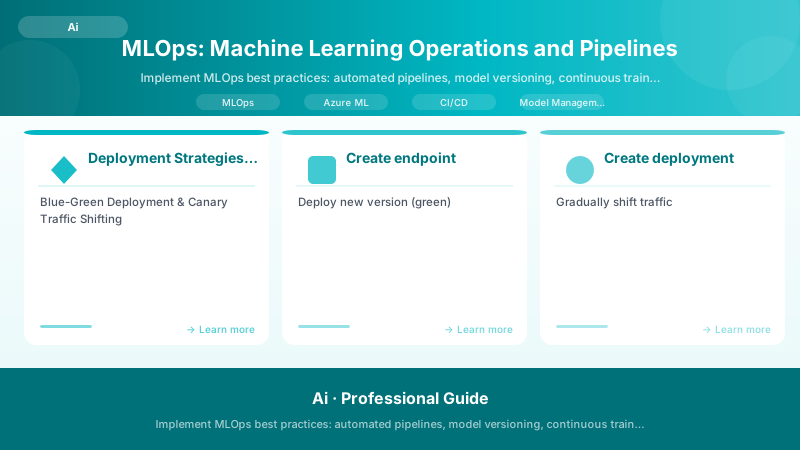
Figure: Azure Front Door – routing rules, WAF policies, and origin health.
## Deploy new version (green)
green_deployment = ManagedOnlineDeployment(
```text
name="green",
endpoint_name="credit-risk-endpoint",
model=new_model,
instance_type="Standard_DS2_v2",
instance_count=1```
)


ml_client.online_deployments.begin_create_or_update(green_deployment)

## Gradually shift traffic
endpoint.traffic = {"blue": 90, "green": 10}
ml_client.online_endpoints.begin_create_or_update(endpoint)


## After validation, switch fully
endpoint.traffic = {"blue": 0, "green": 100}
ml_client.online_endpoints.begin_create_or_update(endpoint)
Batch Inference & Offline Scoring
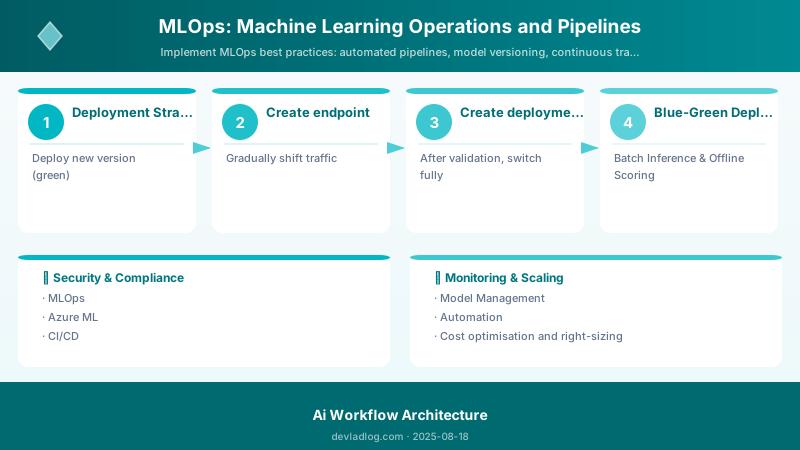
Figure: Configuration and management dashboard with status overview.
from azure.ai.ml.entities import BatchEndpoint, BatchDeployment


batch_endpoint = BatchEndpoint(
```text
name="batch-scoring",
description="Batch scoring endpoint"```
)

batch_deployment = BatchDeployment(
```text
name="production",
endpoint_name="batch-scoring",
model=model,
compute="batch-cluster",
instance_count=4,
max_concurrency_per_instance=2```
)

## Invoke batch job
job = ml_client.batch_endpoints.invoke(
```text
endpoint_name="batch-scoring",
deployment_name="production",
input=Input(path="azureml:batch-input-data:1")```
)
Model Monitoring (Performance, Drift, Quality)
Data Drift Detection (Statistical Tests)
from azure.ai.ml.entities import DataDriftMonitor

monitor = DataDriftMonitor(
```text
name="credit-data-drift",
endpoint_name="credit-risk-endpoint",
deployment_name="blue",
baseline_dataset=baseline_dataset,
target_dataset=production_dataset,
features=["income", "debt_ratio", "credit_score"],
frequency="Week",
alert_enabled=True```
)

ml_client.data_drift_monitors.begin_create_or_update(monitor)
Performance & Resource Tracking
Add accuracy & error rate logging with MLflow, plus system metrics via Azure Monitor queries. Incorporate concept drift by comparing rolling window performance (e.g., last 7 days vs baseline).
def rolling_performance(y_true_history, y_pred_history, window=500):
  import numpy as np
  recent = y_true_history[-window:], y_pred_history[-window:]
  acc = (recent[0] == recent[1]).mean()
  mlflow.log_metric("rolling_accuracy", acc)
  return acc
from azure.monitor import MetricsQueryClient

metrics_client = MetricsQueryClient(credential=DefaultAzureCredential())

## Query endpoint metrics
response = metrics_client.query_resource(
```text
resource_uri=endpoint_resource_id,
metric_names=["RequestLatency", "RequestsPerSecond"],
timespan="PT1H"```
)


for metric in response.metrics:
```text
print(f"{metric.name}: {metric.timeseries[0].data}")
## CI/CD Integration (Azure DevOps & GitHub Actions)

### Azure DevOps Pipeline (Training + Deployment Stages)


```yaml
## azure-pipelines.yml
trigger:
  branches:
```yaml
include:
  - main
pool: vmImage: 'ubuntu-latest'
stages:
- stage: Train
jobs:
  - job: TrainModel
    steps:
      - task: AzureCLI@2
        inputs:
          azureSubscription: 'ML-Service-Connection'
          scriptType: 'bash'
          scriptLocation: 'inlineScript'
          inlineScript: |
            az ml job create --file pipeline.yml
- stage: Deploy
dependsOn: Train
jobs:
  - job: DeployModel
    steps:
      - task: AzureCLI@2
        inputs:
          azureSubscription: 'ML-Service-Connection'
          scriptType: 'bash'
          scriptLocation: 'inlineScript'
          inlineScript: |
            az ml online-deployment create --file deployment.yml
## GitHub Actions Workflow (Infra + Pipeline)

```yaml
name: MLOps Pipeline


on:
  push:
```yaml
branches: [main]
jobs: train-and-deploy:
runs-on: ubuntu-latest
steps:
  - uses: actions/checkout@v2

  - name: Azure Login
    uses: azure/login@v1
    with:
      creds: ${{ secrets.AZURE_CREDENTIALS }}

  - name: Submit Training Pipeline
    run: |
      az ml job create --file pipeline.yml --resource-group ${{ secrets.RESOURCE_GROUP }} --workspace-name ${{ secrets.WORKSPACE_NAME }}

  - name: Deploy Model
    run: |
      az ml online-deployment update --name blue --endpoint credit-risk-endpoint --set traffic=100
## Testing Strategy (Unit, Integration, Validation)

| Layer | Scope | Example Tests | Tooling |
|-------|-------|--------------|---------|
| Unit | Pure functions (feature transforms) | Null handling, scaling correctness | pytest |
| Data Validation | Schema & distribution | Column presence, drift thresholds | Great Expectations |
| Model Quality | Metrics & fairness | Min accuracy, parity diff limits | pytest + custom asserts |
| Integration | Pipeline artifact wiring | Output existence, registry publish | pytest + CLI |
| Deployment | Endpoint health & latency | 95th percentile < target | k6 / locust |
| Monitoring | Alerting rules fire | Simulated drift triggers alerts | synthetic events |


### Sample Pytest for Metric Gate

```python
def test_model_quality():
```text
assert mlflow.get_metric("accuracy") >= 0.85
assert mlflow.get_metric("parity_diff") <= 0.08
## Infrastructure as Code (Bicep & Terraform)

### Bicep Workspace Snippet


```bicep
resource aml 'Microsoft.MachineLearningServices/workspaces@2023-04-01' = {
  name: 'ml-workspace'
  location: resourceGroup().location
  properties: {
```yaml
friendlyName: 'Prod ML'
keyVault: kv.id
storageAccount: sa.id
applicationInsights: ai.id```
  }
}
Terraform for Registry
resource "azurerm_machine_learning_workspace" "ws" {
  name                = "ml-workspace"
  location            = azurerm_resource_group.rg.location
  resource_group_name = azurerm_resource_group.rg.name
  sku_name            = "Basic"
}
Feature Store Pattern (Simplified)
Design principle: consistent offline & online computation. Cache feature transformations; attach metadata (owner, refresh cadence).
class FeatureStore:
```python
def __init__(self, registry):
    self.registry = registry
def compute_credit_utilization(self, df):
    feat = df['current_balance'] / (df['credit_limit'] + 1e-6)
    self.registry.log('credit_utilization', 'v1', 'daily')
    return feat
## Canary Analysis Script

```python
import numpy as np
def canary_diff(champion_preds, canary_preds, y_true):
```python
from sklearn.metrics import accuracy_score
champ_acc = accuracy_score(y_true, champion_preds)
can_acc = accuracy_score(y_true, canary_preds)
diff = can_acc - champ_acc
mlflow.log_metric('canary_accuracy_delta', diff)
return diff
## Promotion Criteria

| Metric | Threshold | Rationale |
|--------|-----------|-----------|
| Accuracy Delta | >= -0.01 | Canary not worse than champion |
| Latency p95 | < 350ms | Performance acceptable |
| Error Rate | < 2% | Stability maintained |
| Drift Score | < 0.05 | Data distribution stable |
| Fairness Parity Diff | < 0.08 | Equity preserved |


## Best Practices

- Version everything: data, code, models, environments
- Automate testing: unit tests, integration tests, model validation
- Use feature stores for consistent features
- Implement gradual rollout for deployments
- Monitor both model performance and system metrics
- Establish rollback procedures
- Document pipeline dependencies
- Use separate environments (dev, staging, prod)


## Troubleshooting

| Issue | Cause | Resolution | Preventive Action |
|-------|-------|------------|------------------|
| Pipeline failure | Dependency conflict | Pin versions, rebuild env | Automated env lock file |
| Deployment timeout | Insufficient resources | Scale instances | Autoscaling rules |
| Data drift alert | Distribution shift | Retrain model | Implement early detection |
| High latency | Inefficient preprocessing | Optimize transforms | Profile & cache features |
| Model not reproducible | Missing env spec | Capture env-lock.yml | Enforce pipeline check |
| Failed canary | Poor generalization | Rollback traffic | Expand validation set |
| Registry version conflict | Duplicate names | Increment semantic version | Pre-deploy naming check |
| Metrics missing | Logging skipped | Add logging wrapper | CI lint on instrumentation |


## Architecture Decision and Tradeoffs

When designing AI/ML solutions with Azure AI Services, consider these key architectural trade-offs:

| Approach | Best For | Tradeoff |
|----------|----------|----------|
| Managed / platform service | Rapid delivery, reduced ops burden | Less customisation, potential vendor lock-in |
| Custom / self-hosted | Full control, advanced tuning | Higher operational overhead and cost |

> **Recommendation:** Start with the managed approach for most workloads and move to custom only when specific requirements demand it.

## Validation and Versioning

- Last validated: April 2026
- Validate examples against your tenant, region, and SKU constraints before production rollout.
- Keep module, CLI, and SDK versions pinned in automation pipelines and review quarterly.

## Security and Governance Considerations

- Apply least-privilege access using RBAC roles and just-in-time elevation for admin tasks.
- Store secrets in managed secret stores and avoid embedding credentials in scripts or source files.
- Enable audit logging, data protection policies, and periodic access reviews for regulated workloads.

## Cost and Performance Notes

- Define budgets and alerts, then monitor usage and cost trends continuously after go-live.
- Baseline performance with synthetic and real-user checks before and after major changes.
- Scale resources with measured thresholds and revisit sizing after usage pattern changes.

## Official Microsoft References

- https://learn.microsoft.com/azure/ai-services/
- https://learn.microsoft.com/azure/machine-learning/
- https://learn.microsoft.com/azure/ai-foundry/

## Public Examples from Official Sources

- These examples are sourced from official public Microsoft documentation and sample repositories.
- Documentation examples: https://learn.microsoft.com/azure/ai-services/
- Sample repositories: https://github.com/Azure-Samples?tab=repositories&q=ai&type=&language=&sort=
- Prefer adapting these examples to your tenant, subscriptions, and governance requirements before production use.

## Key Takeaways

Effective MLOps combines automation, versioning, observability, governance, and controlled rollouts to deliver reliable, adaptable ML systems at scale.


## References

- [Azure ML Pipelines](https://learn.microsoft.com/azure/machine-learning/concept-ml-pipelines)
- [Deploy Online Endpoints](https://learn.microsoft.com/azure/machine-learning/how-to-deploy-online-endpoints)
- [MLflow Tracking](https://mlflow.org/docs/latest/index.html)
- [Data Versioning with DVC](https://dvc.org/doc)
- [Azure Monitor Metrics](https://learn.microsoft.com/azure/azure-monitor/)
- [Great Expectations](https://greatexpectations.io/)
- [Terraform AzureRM Provider](https://registry.terraform.io/providers/hashicorp/azurerm/latest/docs)


## Advanced Pipeline Patterns

### Parallel & Conditional Steps (Hyperparameter + Conditional Promotion)


```python
from azure.ai.ml.dsl import pipeline

@pipeline(name="advanced_training_pipeline")
def advanced_pipeline(train_data, test_data):
  sweep_jobs = []
  for depth in [3,5,7]:
```text
job = train_component(training_data=train_data, overrides={"max_depth": depth})
sweep_jobs.append(job)```
  # Parallel hyperparameter sweeps auto-run concurrently
  eval_jobs = [
```text
eval_component(model_input=j.outputs.model_output, test_data=test_data)
for j in sweep_jobs```
  ]
  # Conditional register best performing model
  from azure.ai.ml import Output
  # (Pseudo) select best based on metric
  best = eval_jobs[0]  # replaced later with comparison logic
  return {"champion_model": best.inputs.model_input}
Dynamic Branching Logic (Metric Gate)
def should_promote(metrics: dict):
  return (
```text
metrics["accuracy"] >= 0.86 and
metrics["fairness_parity"] <= 0.08 and
metrics["latency_p95"] < 350```
  )
Data & Feature Versioning (DVC + Lineage)
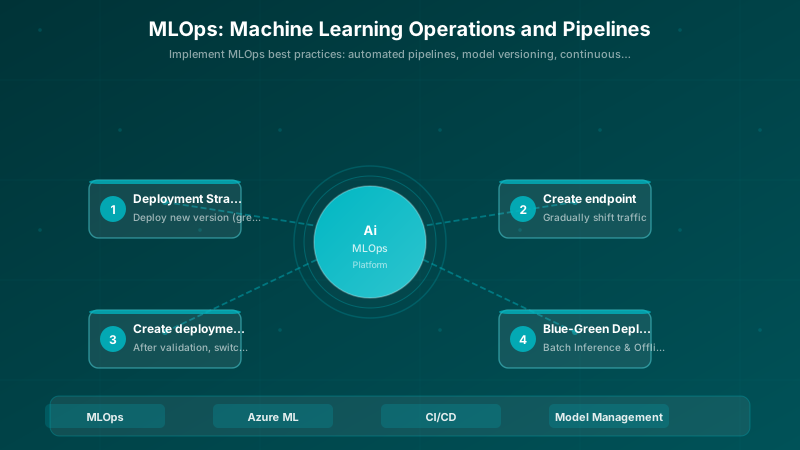
Figure: Temporal table results – system-versioned history with period columns.
## Initialize DVC and remote
dvc init
dvc remote add origin azure://myblobcontainer/dvcstore


## Track raw and processed datasets
dvc add data/raw/credit.csv
dvc add data/processed/credit_clean.parquet


## Generate pipeline stages
dvc stage add -n preprocess -d src/preprocess.py -d data/raw/credit.csv -o data/processed/credit_clean.parquet \
  python src/preprocess.py --in data/raw/credit.csv --out data/processed/credit_clean.parquet


## Push artifacts & metadata
git add .
git commit -m "Add data lineage"
dvc push
Lineage binding combines DVC file hashes + code commit + environment lock to produce a composite provenance record:
import hashlib, json

def composite_lineage(files):
  h = hashlib.sha256()
  for f in files:
```sql
with open(f,'rb') as fh:
  h.update(fh.read())```
  return h.hexdigest()

record = {
  "data_hash": composite_lineage(["data/processed/credit_clean.parquet.dvc"]),
  "code_commit": os.getenv("GIT_COMMIT"),
  "env_lock": open("env-lock.yml").read()
}
open("lineage.json","w").write(json.dumps(record, indent=2))
Concept & Data Drift Deep Dive
Combine statistical tests (KS, PSI) + embedding shift for text features.
from scipy.stats import ks_2samp
import numpy as np

def population_stability_index(expected, actual, bins=10):
  expected_hist, _ = np.histogram(expected, bins=bins)
  actual_hist, _ = np.histogram(actual, bins=bins)
  psi = 0.0
  for e,a in zip(expected_hist, actual_hist):
```text
if e == 0 or a == 0: continue
ratio = (a/len(actual)) / (e/len(expected))
psi += (a/len(actual) - e/len(expected)) * np.log(ratio)```
  return psi

def drift_report(baseline, production):
  report = {}
  for col in baseline.columns:
```text
ks_p = ks_2samp(baseline[col], production[col]).pvalue
psi = population_stability_index(baseline[col], production[col])
report[col] = {"ks_p": ks_p, "psi": psi}```
  return report
Threshold Guidelines: KS p-value < 0.05 or PSI > 0.2 triggers retraining candidate evaluation.
Retraining Orchestration Logic
Figure: Azure ML Studio – training pipeline, metrics, and model registry.
def evaluate_retraining_trigger(drift_scores, perf_delta, time_since_last):
  if any(d['psi'] > 0.2 for d in drift_scores.values()):
```text
return "drift"```
  if perf_delta < -0.03:  # accuracy dropped more than 3%
```text
return "performance"```
  if time_since_last.days >= 30:
```text
return "stale"```
  return None
When trigger reason != None: submit pipeline with label metadata trigger_reason for audit.
Security & Compliance Controls
| Control | Implementation | Tooling |
|---|---|---|
| Secrets Management | Key Vault references in workspace | Azure Key Vault |
| Network Isolation | Private endpoints + VNet injection | Azure ML VNet |
| Image Vulnerability Scan | Scan base container before deploy | Trivy / Defender |
| RBAC Segmentation | Least privilege roles (Reader, Data Scientist, Approver) | Azure RBAC |
| Policy Enforcement | Deny public endpoints, enforce encryption | Azure Policy |
| Audit Logging | Centralized actions (deploy, approve, rollback) | Log Analytics + KQL |
Sample KQL (Deployment Approvals)
AzureActivity
| where OperationName =~ "Create Or Update Deployment"
| project TimeGenerated, Caller, ResultType, CorrelationId
Cost Optimization Strategies
| Area | Strategy | Impact |
|---|---|---|
| Compute | Use spot/low-priority for batch training | 30–70% savings |
| Autoscaling | Scale out on p95 latency > threshold | Avoid over-provision |
| Feature Engineering | Cache expensive aggregations | Reduce pipeline run time |
| Model Selection | Early stop underperforming sweeps | Lower GPU hours |
| Storage | Lifecycle policies for old artifacts | Lower storage costs |
| Monitoring | Sample inference logging (e.g., 5%) | Control telemetry spend |
Maturity Model
| Level | Characteristics | Focus |
|---|---|---|
| 1 Ad-hoc | Manual scripts, no tracking | Establish versioning |
| 2 Repeatable | Some pipeline jobs, partial logging | Metric standardization |
| 3 Defined | CI/CD, registry, monitoring baseline | Quality gates |
| 4 Managed | Drift detection, retraining triggers | SLA enforcement |
| 5 Optimizing | A/B experimentation, cost governance | Continuous improvement |
| 6 Autonomous | Self-healing pipelines, adaptive retraining | Policy-driven optimization |
KPI Catalog
| KPI | Definition | Target |
|---|---|---|
| Lead Time | Commit → Production deploy time | < 2h |
| Deployment Frequency | Successful prod releases / week | ≥ 5 |
| Change Failure Rate | Failed deploys requiring rollback | < 5% |
| MTTR | Mean time to restore after incident | < 30 min |
| Drift Reaction Time | Drift detection → retraining start | < 24h |
| Reproducibility Score | % runs reproduce metrics | 100% |
| Fairness Regression | Parity change vs baseline | ≤ 0.02 |
| Cost per 1000 Predictions | Inference total / volume | Trending ↓ |
Extended Best Practices & Anti-Patterns
| Do | Reason | Avoid | Risk |
|---|---|---|---|
| Hash lineage artifacts | Ensures reproducibility | Rely on timestamps | Ambiguous provenance |
| Implement composite gates | Prevent regressions | Single-metric gating | Hidden bias/perf drop |
| Separate dev/stage/prod | Contained risk | Testing in prod | Customer impact |
| Automate rollback | Fast recovery | Manual redeploy | Extended outage |
| Document feature semantics | Maintain clarity | Tribal knowledge | Rework & errors |
| Monitor fairness + drift | Early issue detection | Only accuracy | Ethical/regulatory risk |
Environment Drift Detection
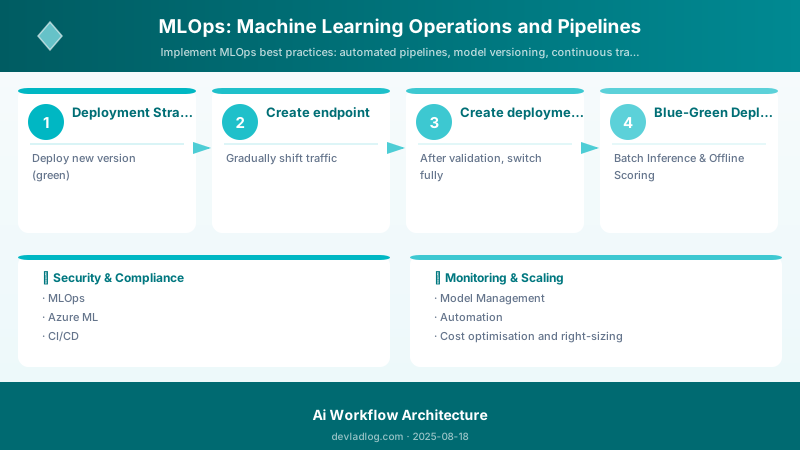
Figure: Configuration and management dashboard with status overview.
import yaml, subprocess


def current_env_spec():
  out = subprocess.check_output(["pip","freeze"]).decode()
  return sorted(out.splitlines())

baseline = open("env-lock.yml").read().splitlines()
drift = [p for p in current_env_spec() if p not in baseline]
if drift:
  print("Environment drift detected:", drift)
Scaling & Performance Engineering
- Use load testing (k6, locust) pre-promotion.
- Profile endpoints (CPU, memory) with sampling profiler.
- Apply autoscaling on p95 latency + queue depth signals.
- Use model quantization or distillation for heavy architectures.
- Employ warm pools to reduce cold start latency.
Rollback & Disaster Recovery
Rollback trigger conditions: error rate spike > 3x baseline, latency p95 > SLA + 25%, critical metric regression > 2%. Execute traffic shift to previous stable deployment + open incident ticket with root cause template.
FAQs
| Question | Answer |
|---|---|
| How do I decide retraining cadence? | Combine drift metrics, performance decay, and business cycle (e.g., monthly) |
| What if fairness improves but accuracy drops? | Evaluate net business impact; may accept trade-off if accuracy within tolerance |
| How are secrets rotated? | Managed via Key Vault with quarterly rotation policy and automated pipeline update |
| How do I handle large feature sets? | Prune low-importance features; maintain feature importance registry; apply sparse techniques |
| Should I store raw data forever? | Retain per compliance & privacy rules; apply lifecycle deletion policies |
| How to manage multi-model ensembles? | Track component models separately; create ensemble manifest with versions |
| What triggers rollback automatically? | Canary delta beyond thresholds, spike in error, SLA violation events |
| How to audit lineage quickly? | Query combined lineage JSON + registry metadata via reporting script |
Additional References
- Azure ML Responsible AI
- Azure Policy for ML
- Key Vault Integration
- Autoscaling Patterns
- PSI Calculation
Service Levels (SLO / SLA / Error Budgets)
Define clear reliability expectations for ML serving:
| Dimension | SLI (Metric) | SLO Target | SLA (External) | Error Budget |
|---|---|---|---|---|
| Availability | Successful request ratio | 99.5% monthly | 99.0% | 0.5% downtime or failed calls |
| Latency | p95 response time | < 350 ms | < 400 ms | 50 ms headroom |
| Correctness | Rolling accuracy vs baseline | ≥ baseline -1% | Baseline -2% | 1% degradation allowance |
| Freshness | Max model age | < 30 days | < 45 days | 15 day buffer |
| Fairness | Parity diff (worst group) | ≤ 0.08 | ≤ 0.10 | 0.02 tolerance |
Error budget usage informs release velocity; if exhausted, freeze feature changes, prioritize reliability/drift fixes.
Incident Response Runbook (Template)
- Triage: Identify alert type (latency, drift, fairness, correctness).
- Scope: Determine impacted endpoints, traffic %, user segments.
- Mitigation: Apply rollback (traffic shift), scale resources, or disable risky feature flags.
- Diagnosis: Pull KQL queries (latency, drift, fairness) + recent deployment diff.
- Communication: Post status update (Internal channel + status page if SLA breach).
- Resolution: Implement fix (hot patch, retrain, config tune).
- Postmortem: Document root cause + action items (automation, tests, guardrails).
Root Cause Template (Excerpt)
Issue: High latency spike post canary promotion
Cause: Missing warm-up routine; model cold start + autoscaling delay
Impact: p95 latency 780ms for 12 minutes (SLO breach)
Actions: Add warm pool, pre-load embeddings cache, adjust autoscaling thresholds
Preventive Controls: Performance regression test, synthetic load pre-promotion
Enhanced Monitoring (KQL Queries)
Latency & Error Trend
AppRequests
| where Name == "credit-risk-endpoint"
| summarize p95Latency=percentile(DurationMs,95), errorRate=countif(ResultCode >= 500)/count() by bin(TimeGenerated, 5m)
| render timechart
Drift & Fairness Metrics (Custom Logs)
CustomMetrics
| where MetricName in ("psi_income", "psi_credit_score", "fairness_parity_diff")
| project TimeGenerated, MetricName, MetricValue
| summarize avg(MetricValue) by MetricName, bin(TimeGenerated, 1h)
Canary vs Champion Comparison
CustomMetrics
| where MetricName in ("champ_accuracy", "canary_accuracy")
| summarize champ=avgif(MetricValue, MetricName=="champ_accuracy"), canary=avgif(MetricValue, MetricName=="canary_accuracy") by bin(TimeGenerated, 30m)
| extend delta = canary - champ
Shadow & Bandit Deployment Strategies
| Strategy | Description | Use Case | Risk |
|---|---|---|---|
| Shadow Testing | New model receives mirrored traffic; responses not returned to user | Non-regression validation | Resource overhead |
| Canary | Partial traffic routed; metrics compared | Gradual rollout | Needs gating discipline |
| A/B (Fixed Split) | Two versions share traffic; track uplift | UI/content or model improvements | Longer evaluation window |
| Multi-Armed Bandit | Adaptive traffic based on live reward | Optimize conversions dynamically | Complex reward design |
Shadow establishes safety; bandit optimizes exploitation vs exploration under controlled fairness constraints.
Promotion Gate Script (Composite Validation)
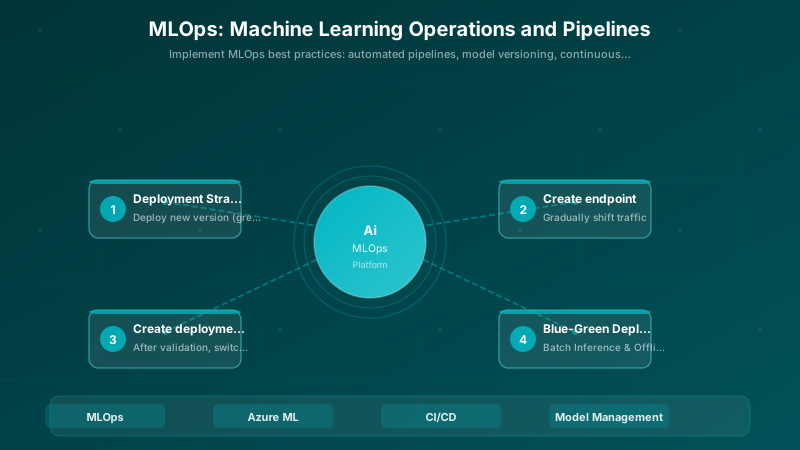
Figure: SharePoint hub site – connected sites navigation and news web parts.
def promotion_gate(metrics):
  checks = {
```text
"accuracy": metrics["accuracy"] >= 0.85,
"fairness": metrics["parity_diff"] <= 0.08,
"latency": metrics["p95_latency_ms"] < 350,
"drift": metrics["avg_psi"] < 0.2,
"error_rate": metrics["error_rate"] < 0.02```
  }
  failed = [k for k,v in checks.items() if not v]
  if failed:
```powershell


mlflow.log_param("promotion_gate", f"FAILED:{','.join(failed)}")
return False```
  mlflow.log_param("promotion_gate", "PASSED")
  return True
Model Explanation Integration (SHAP Gate)
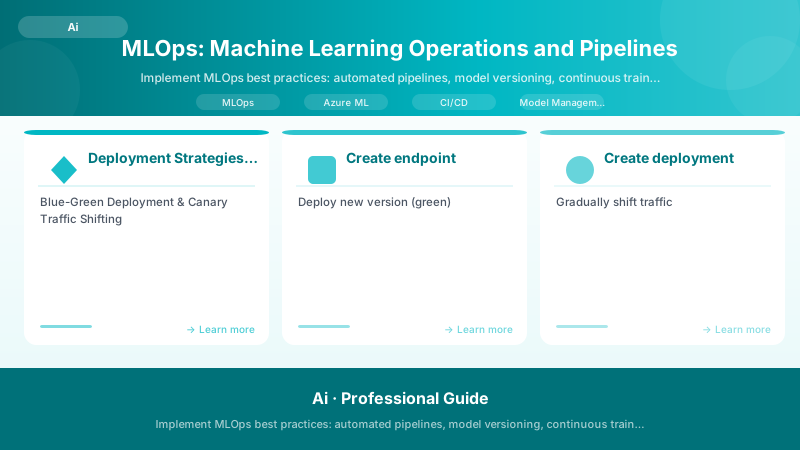
Figure: Azure ML Studio – training pipeline, metrics, and model registry.
import shap


def shap_consistency(model, X_sample, top_n=5):
  explainer = shap.TreeExplainer(model)
  vals = explainer.shap_values(X_sample)
  mean_abs = np.abs(vals).mean(axis=0)
  top_features = X_sample.columns[np.argsort(mean_abs)[-top_n:]]
  mlflow.log_artifact("shap_top_features.txt")
  open("shap_top_features.txt","w").write("\n".join(top_features))
  return top_features
Gate can enforce stability (e.g., expected core features remain in top list across versions).
Pipeline Optimization Techniques
- Cache intermediate feature sets for iterative experiments.
- Use lightweight models for early sweep pruning before heavy architectures.
- Parallelize data validation + feature extraction stages.
- Adopt container layer caching (shared base image for Python deps).
- Use distributed training only beyond dataset size / complexity thresholds.
Expanded Troubleshooting Matrix (Additions)
| Issue | Cause | Resolution | Preventive Action |
|---|---|---|---|
| Fairness regression | Distribution shift in subgroup | Retrain with reweight / constraints | Continuous subgroup monitoring |
| Cost spike | Unbounded sweep search | Cap trials + early stopping | Budget-aware scheduler |
| Metrics delay | Telemetry ingestion lag | Investigate Log Analytics latency | Implement buffering & retry |
| Env drift | Untracked dependency added | Rebuild from lock, update lock file | Immutable build images |
| Stale canary | Canary not promoted or rolled back | Review decision gates | Set max canary duration SLA |
| Slow retraining | Inefficient data loading | Optimize IO, parquet usage | Profile pipeline steps |
| Registry clutter | Excess obsolete versions | Archive & purge policy | Scheduled cleanup job |
Security & Compliance Checklist
- [ ] Key Vault secrets mounted via URI references
- [ ] Private endpoint enabled for workspace & storage
- [ ] All deployments use approved base images (scanned)
- [ ] RBAC roles reviewed quarterly
- [ ] Policies enforce HTTPS & encryption at rest
- [ ] Lineage JSON generated & stored per version
- [ ] Fairness & drift metrics logged hourly
- [ ] Promotion gate result persisted
Quality Scoreboard (Example)
| Version | Accuracy | Fairness Diff | Drift PSI | Latency p95 | Status |
|---|---|---|---|---|---|
| 1.0 | 0.872 | 0.05 | 0.08 | 310ms | Champion |
| 1.1 | 0.879 | 0.06 | 0.07 | 305ms | Shadow |
| 1.2 | 0.881 | 0.05 | 0.09 | 315ms | Canary |
| 1.3 | 0.890 | 0.07 | 0.06 | 298ms | Candidate |
Track evolution; degrade detection triggers investigation before user impact.
Final Thoughts
Robust MLOps transforms model delivery from artisanal bursts to engineered, measurable, and continuously improving systems—balancing velocity, reliability, ethics, and cost efficiency.
Discussion